Krishan Sukriti, Koach Jessica, Lim Taylor, Yeo Kenny, Cheong Faith, Luo Jie-Si, Massudi Hassina, Gao Xiaomian, Heangsarath Sopheakwealthy, Kueh Andrew J, Herold Marco J, Cheung Belamy B, Marshall Glenn M
Children's Cancer Institute Australia for Medical Research, Lowy Cancer Research Centre, University of New South Wales Sydney (UNSW), Sydney, NSW 2052, Australia.
School of Clinical Medicine, UNSW Medicine & Health, University of New South Wales Sydney (UNSW), Sydney, NSW 2052, Australia.
Cells. 2025 Sep 11;14(18):1422. doi: 10.3390/cells14181422.
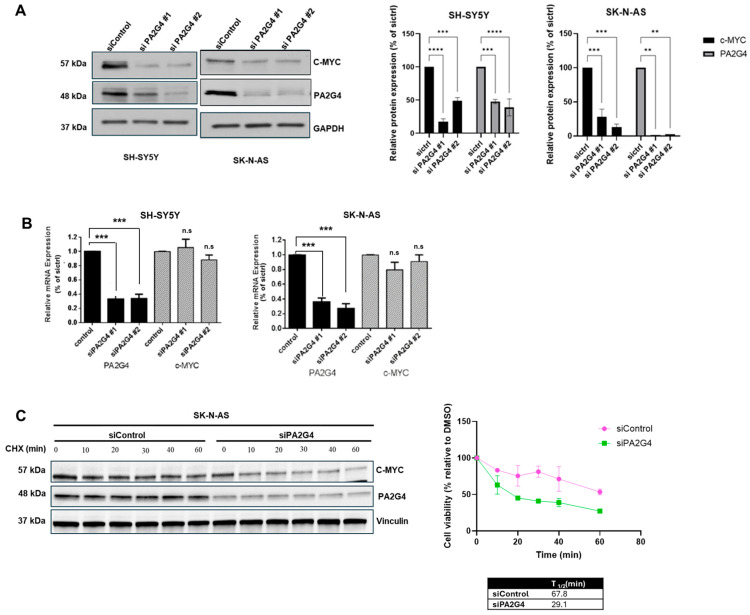
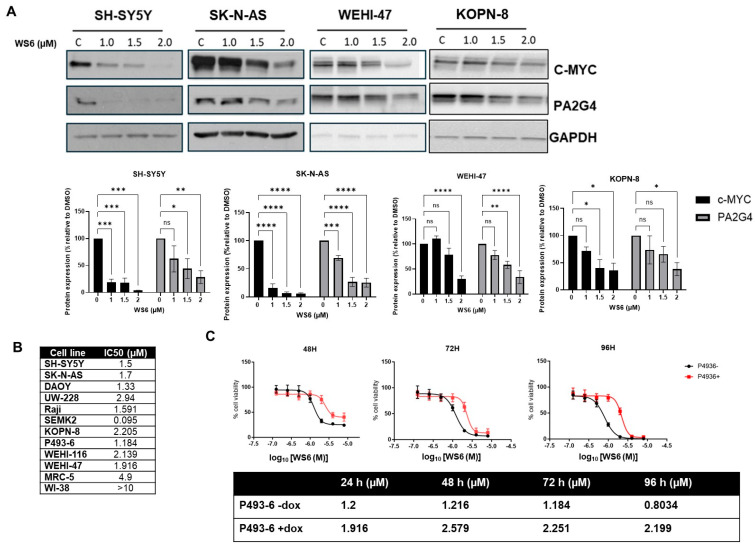
MYCN and c-MYC are critical driver oncogenes in several childhood cancers, including neuroblastoma. Currently, the clinical development of MYC inhibitors has been hindered by the intrinsically disordered structure of MYC proteins, which lack well-defined ligand-binding pockets. Proliferation-associated protein 2G4 (PA2G4) directly binds to and stabilizes MYCN protein, leading to markedly increased MYCN levels in neuroblastoma cells. Here, we demonstrate that PA2G4 is essential for MYCN-driven tumor growth in neuroblastoma in vivo. Moreover, PA2G4 elevates c-MYC protein levels in neuroblastoma cells by inhibiting its ubiquitin-mediated degradation. In turn, c-MYC upregulates the transcription and protein expression of PA2G4, creating an oncogenic feed-forward expression loop. A small molecule PA2G4 inhibitor, WS6, directly disrupts the PA2G4-c-MYC protein-protein interaction, resulting in decreased levels of both PA2G4 and c-MYC. WS6 exhibited selective cytotoxicity in c-MYC-overexpressing cell lines. Together, these findings identify PA2G4 as a shared cofactor for both the c-MYC and MYCN oncoproteins and highlight its interaction with MYC family oncoproteins as a promising therapeutic vulnerability in MYC-driven cancers.
MYCN和c-MYC是包括神经母细胞瘤在内的几种儿童癌症中的关键驱动癌基因。目前,MYC抑制剂的临床开发受到MYC蛋白内在无序结构的阻碍,该结构缺乏明确的配体结合口袋。增殖相关蛋白2G4(PA2G4)直接结合并稳定MYCN蛋白,导致神经母细胞瘤细胞中MYCN水平显著升高。在这里,我们证明PA2G4对于体内神经母细胞瘤中MYCN驱动的肿瘤生长至关重要。此外,PA2G4通过抑制神经母细胞瘤细胞中c-MYC的泛素介导降解来提高其蛋白水平。反过来,c-MYC上调PA2G4的转录和蛋白表达,形成一个致癌的前馈表达环。一种小分子PA2G4抑制剂WS6直接破坏PA2G4-c-MYC蛋白-蛋白相互作用,导致PA2G4和c-MYC水平降低。WS6在c-MYC过表达的细胞系中表现出选择性细胞毒性。总之,这些发现确定PA2G4是c-MYC和MYCN癌蛋白的共同辅助因子,并突出了其与MYC家族癌蛋白的相互作用作为MYC驱动癌症中一个有前景的治疗靶点。