Soroushmojdehi Rahil, Vidmark Jessica S L, Seyyed Mousavi S Alireza, Abe Sumiko, Sanger Terence D
Department of Electrical Engineering and Computer Science, University of California, Irvine, CA, USA.
Department of Biomedical Engineering, University of California, Irvine, CA, USA.
Sci Rep. 2025 Sep 29;15(1):33551. doi: 10.1038/s41598-025-18436-6.
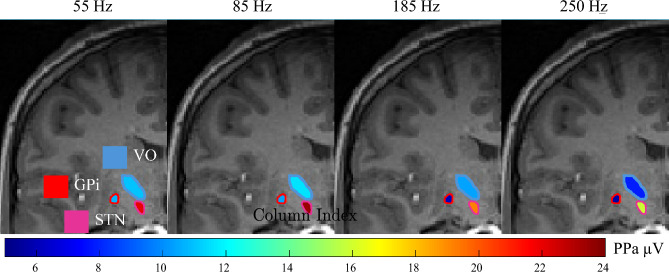
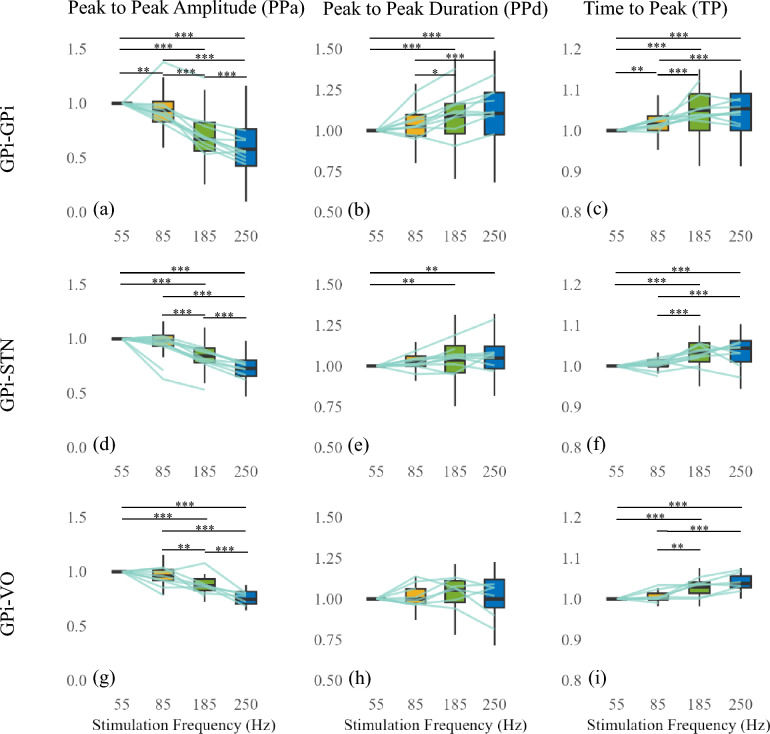
Deep brain stimulation (DBS) of the globus pallidus internus (GPi) is an established treatment for dystonia, yet the neurophysiological mechanisms underlying frequency-dependent effects remain poorly understood. In this study, we investigate how different GPi-DBS frequencies modulate evoked potential (EP) characteristics within the basal ganglia-thalamo-cortical network in pediatric dystonia patients. We evaluated how increasing stimulation frequency alters EP morphology, focusing on peak-to-peak amplitude (PPa), peak-to-peak duration (PPd), and time to peak (TP). This analysis was motivated by clinical observations that higher DBS frequencies often produce distinct therapeutic effects, suggesting underlying differences in how neural circuits respond to varying stimulation rates. We analyzed intracranial electrophysiological recordings from 13 pediatric and young adult dystonia patients undergoing staged DBS implantation. EPs were recorded from the GPi and subthalamic nucleus (STN) of basal ganglia, and ventral oralis (VO) nucleus of the thalamus during unilateral GPi stimulation at 55, 85, 185, and 250 Hz. EP detection and characterization were performed using an automated algorithm, and group-level analyses were conducted using linear mixed effects models to assess frequency-dependent changes across regions. Increasing stimulation frequency significantly decreased PPa and increased PPd and TP, with a clear threshold effect: 55 Hz and 85 Hz produced similar responses, while 185 Hz and 250 Hz elicited significantly greater changes. These frequency-dependent effects were most pronounced in GPi recordings, followed by STN and VO, suggesting that local circuit dynamics are more sensitive to frequency modulation. Our findings highlight the distinct neurophysiological effects of DBS frequency on EP characteristics, emphasizing the need for personalized DBS programming. The pronounced frequency-dependent modulation observed in GPi suggests that optimal stimulation parameters should be tailored to the target region rather than applying uniform settings across patients. Future studies should investigate the clinical relevance of these EP dynamics and explore their potential as biomarkers for DBS optimization in dystonia.
内侧苍白球(GPi)的深部脑刺激(DBS)是治疗肌张力障碍的一种既定方法,但其频率依赖性效应背后的神经生理机制仍知之甚少。在本研究中,我们调查了不同的GPi-DBS频率如何调节小儿肌张力障碍患者基底神经节-丘脑-皮质网络内的诱发电位(EP)特征。我们评估了增加刺激频率如何改变EP形态,重点关注峰峰值幅度(PPa)、峰峰持续时间(PPd)和峰值时间(TP)。这一分析的动机来自临床观察,即较高的DBS频率通常会产生明显的治疗效果,这表明神经回路对不同刺激速率的反应存在潜在差异。我们分析了13名接受分期DBS植入的小儿和年轻成人肌张力障碍患者的颅内电生理记录。在以55、85、185和250 Hz的频率单侧刺激GPi期间,从基底神经节的GPi和丘脑底核(STN)以及丘脑腹口核(VO)记录EP。使用自动算法进行EP检测和特征分析,并使用线性混合效应模型进行组水平分析,以评估各区域的频率依赖性变化。增加刺激频率显著降低PPa并增加PPd和TP,具有明显的阈值效应:55 Hz和85 Hz产生相似的反应,而185 Hz和250 Hz引起的变化明显更大。这些频率依赖性效应在GPi记录中最为明显,其次是STN和VO,表明局部回路动力学对频率调制更敏感。我们的研究结果突出了DBS频率对EP特征的独特神经生理效应,强调了个性化DBS编程的必要性。在GPi中观察到的明显的频率依赖性调制表明,最佳刺激参数应根据目标区域进行调整,而不是对所有患者应用统一的设置。未来的研究应调查这些EP动力学的临床相关性,并探索它们作为肌张力障碍DBS优化生物标志物的潜力。