
坦桑尼亚西北部姆万扎地区新诊断的未接受抗逆转录病毒治疗的HIV感染者中勃起功能障碍的患病率及相关因素:一项横断面研究
Prevalence of erectile dysfunction and associated factors among newly diagnosed ART naïve men living with HIV: a cross sectional study in Mwanza, Northwestern Tanzania.
作者信息
Iddi Shabani, Matovelo Dismas, Marwa Karol J, Kidenya Benson R, Dika Haruna, Kalluvya Samuel E
机构信息
Department of Physiology, Weill Bugando School of Medicine, Catholic University of Health and Allied Sciences, Mwanza, Tanzania.
Department of Obstetrics and Gynecology, Weill Bugando School of Medicine, Catholic University of Health and Allied Sciences, Mwanza, Tanzania.
出版信息
Front Urol. 2025 Sep 16;5:1657553. doi: 10.3389/fruro.2025.1657553. eCollection 2025.
BACKGROUND
Erectile dysfunction (ED) is a frequent finding in men living with human immunodeficiency virus (HIV) (MLWH) and this remains a major concern because of its negative impact on the quality of life of those affected. There is limited data about the magnitude of ED and associated factors among MLWH in Tanzania. Thus this study was aimed to determine the prevalence of ED and associated factors among newly diagnosed antiretroviral therapy (ART)-naive MLWH in Mwanza, Northwestern Tanzania.
METHODS
A cross-sectional study was conducted among 373 newly diagnosed ART-naïve MLWH attending voluntary counseling and testing centers of four selected hospitals in Mwanza region who were consecutively enrolled and subjected to thorough clinical and general physical examination, including anthropometric measurements. A pre-structured questionnaire was used to collect socio-demographic characteristics and clinical data. ED was assessed using the International Index of Erectile Function-5. Serum total testosterone, follicle-stimulating hormone, luteinizing hormone and estradiol were estimated. Data were entered in Microsoft Excel, cleaned and analyzed using STATA version 15.
RESULTS
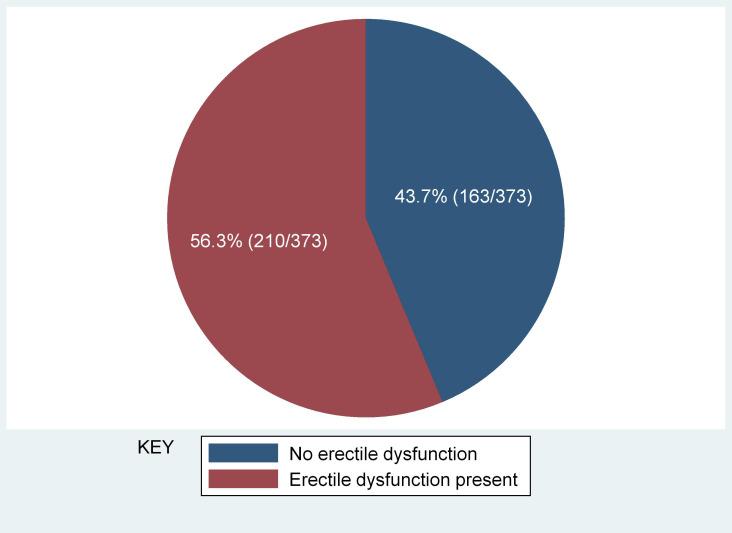
Of the 373 analyzed participants with a median age of 40 [IQR: 33-46] years, ED was found in 56.3% (95% CI 51.2%-61.3%), whereas the majority presented with mild (45.2%) to mild-moderate (40.0%) ED. The median testosterone was significantly lower in men with ED as compared with men without (294.5 [135-469] versus 482 [191-602] ng/ml; p0.001). In a multivariate logistic regression analysis, ED showed significant association with World Health Organization (WHO) clinical stage 4 for HIV infection (AOR 3.2; 95% CI 1.1-9.2; p=0.032), low testosterone level (AOR 1.9; 95% CI 1.2-3.0; p=0.010), and being non-self-employed (AOR 3.7; 95% CI 2.0-7.0; p<0.001).
CONCLUSION
ED was found in more than half of ART naïve MLWH. The majority had a mild to mild-moderate ED. There was a significant association between ED and WHO clinical stage 4 for HIV infection, low testosterone level, and being non-self-employed. This finding emphasizes the need to routinely screen for early detection and management of ED in care and treatment center (CTC) clinics.
背景
勃起功能障碍(ED)在感染人类免疫缺陷病毒(HIV)的男性(MLWH)中很常见,由于其对受影响者生活质量的负面影响,这仍然是一个主要问题。关于坦桑尼亚MLWH中ED的严重程度和相关因素的数据有限。因此,本研究旨在确定坦桑尼亚西北部姆万扎地区新诊断的未接受抗逆转录病毒治疗(ART)的MLWH中ED的患病率及其相关因素。
方法
对姆万扎地区四家选定医院的自愿咨询和检测中心的373名新诊断的未接受ART的MLWH进行了一项横断面研究,这些患者被连续纳入并接受了全面的临床和全身检查,包括人体测量。使用预先构建的问卷收集社会人口学特征和临床数据。使用国际勃起功能指数-5评估ED。测定血清总睾酮、促卵泡生成素、促黄体生成素和雌二醇。数据录入Microsoft Excel,清理后使用STATA 15版本进行分析。
结果
在373名分析参与者中,年龄中位数为40岁[四分位间距:33 - 46岁],发现56.3%(95%置信区间51.2% - 61.3%)存在ED,其中大多数表现为轻度(45.2%)至轻度 - 中度(40.0%)ED。与无ED的男性相比,有ED的男性睾酮中位数显著更低(294.5 [135 - 469] 对 482 [191 - 602] ng/ml;p<0.001)。在多因素逻辑回归分析中,ED与世界卫生组织(WHO)HIV感染临床分期4(调整后比值比[AOR] 3.2;95%置信区间1.1 - 9.2;p = 0.032)、低睾酮水平(AOR 1.9;95%置信区间1.2 - 3.0;p = 0.010)以及非个体经营者(AOR 3.7;95%置信区间2.0 - 7.0;p<0.001)显著相关。
结论
在超过一半的未接受ART的MLWH中发现了ED。大多数为轻度至轻度 - 中度ED。ED与WHO HIV感染临床分期4、低睾酮水平以及非个体经营者之间存在显著关联。这一发现强调了在护理和治疗中心(CTC)诊所常规筛查以早期发现和管理ED的必要性。

 Zotero 插件