Hammes W, Schleifer K H, Kandler O
J Bacteriol. 1973 Nov;116(2):1029-53. doi: 10.1128/jb.116.2.1029-1053.1973.
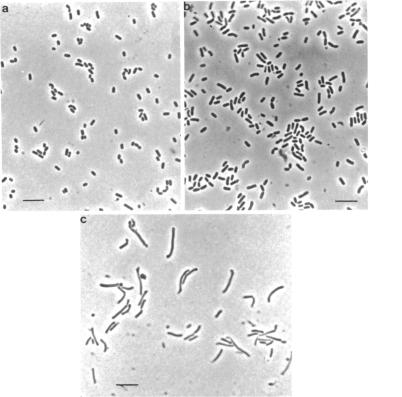
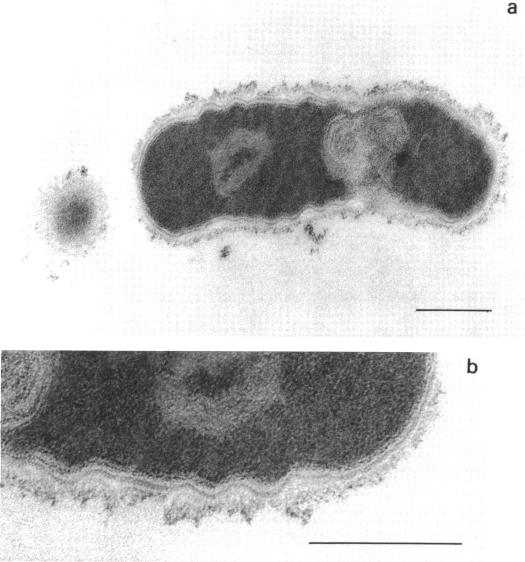
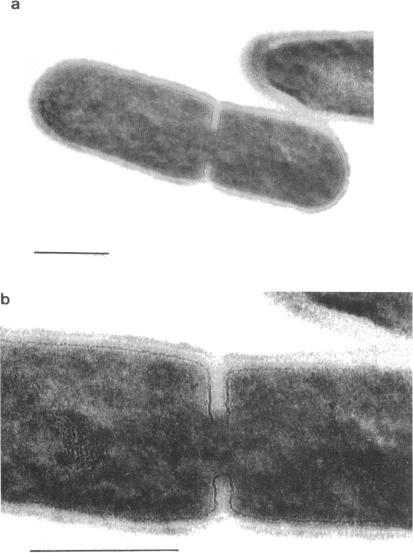
The mechanism of glycine action in growth inhibition was studied on eight different species of bacteria of various genera representing the four most common peptidoglycan types. To inhibit the growth of the different organisms to 80%, glycine concentrations from 0.05 to 1.33 M had to be applied. The inhibited cells showed morphological aberrations. It has been demonstrated that glycine is incorporated into the nucleotide-activated peptidoglycan precursors. The amount of incorporated glycine was equivalent to the decrease in the amount of alanine. With one exception glycine is also incorporated into the peptidoglycan. Studies on the primary structure of both the peptidoglycan precursors and the corresponding peptidoglycan have revealed that glycine can replace l-alanine in position 1 and d-alanine residues in positions 4 and 5 of the peptide subunit. Replacement of l-alanine in position 1 of the peptide subunit together with an accumulation of uridine diphosphate-muramic acid (UDP-MurNAc), indicating an inhibition of the UDP-MurNAc:l-Ala ligase, has been found in three bacteria (Staphylococcus aureus, Lactobacillus cellobiosus and L. plantarum). However, discrimination against precursors with glycine in position 1 in peptidoglycan synthesis has been observed only in S. aureus. Replacement of d-alanine residues was most common. It occurred in the peptidoglycan with one exception in all strains studied. In Corynebacterium sp., C. callunae, L. plantarum, and L. cellobiosus most of the d-alanine replacing glycine occurs C-terminal in position 4, and in C. insidiosum and S. aureus glycine is found C-terminal in position 5. It is suggested that the modified peptidoglycan precursors are accumulated by being poor substrates for some of the enzymes involved in peptidoglycan synthesis. Two mechanisms leading to a more loosely cross-linked peptidoglycan and to morphological changes of the cells are considered. First, the accumulation of glycine-containing precursors may lead to a disrupture of the normal balance between peptidoglycan synthesis and controlled enzymatic hydrolysis during growth. Second, the modified glycine-containing precursors may be incorporated. Since these are poor substrates in the transpeptidation reaction, a high percentage of muropeptides remains uncross-linked. The second mechanism may be the more significant in most cases.
在代表四种最常见肽聚糖类型的不同属的八种不同细菌物种上研究了甘氨酸在生长抑制中的作用机制。为了将不同生物体的生长抑制80%,必须施加0.05至1.33 M的甘氨酸浓度。受抑制的细胞表现出形态畸变。已证明甘氨酸被掺入核苷酸活化的肽聚糖前体中。掺入的甘氨酸量相当于丙氨酸量的减少。除了一个例外,甘氨酸也被掺入肽聚糖中。对肽聚糖前体和相应肽聚糖的一级结构的研究表明,甘氨酸可以取代肽亚基第1位的L-丙氨酸以及第4和5位的D-丙氨酸残基。在三种细菌(金黄色葡萄球菌、纤维二糖乳杆菌和植物乳杆菌)中发现,肽亚基第1位的L-丙氨酸被取代,同时尿苷二磷酸-胞壁酸(UDP-MurNAc)积累,表明UDP-MurNAc:L-丙氨酸连接酶受到抑制。然而,仅在金黄色葡萄球菌中观察到肽聚糖合成中对第1位含有甘氨酸的前体的歧视。D-丙氨酸残基的取代最为常见。在所研究的所有菌株中,除了一个例外,它都发生在肽聚糖中。在棒状杆菌属、卡鲁纳棒状杆菌、植物乳杆菌和纤维二糖乳杆菌中,大多数取代甘氨酸的D-丙氨酸出现在第4位的C末端,而在阴险棒状杆菌和金黄色葡萄球菌中,甘氨酸出现在第5位的C末端。有人认为,修饰的肽聚糖前体由于是参与肽聚糖合成的一些酶的不良底物而积累。考虑了导致肽聚糖交联更松散和细胞形态变化的两种机制。首先,含甘氨酸前体的积累可能导致生长过程中肽聚糖合成与受控酶促水解之间的正常平衡被破坏。其次,可能会掺入修饰的含甘氨酸前体。由于这些在转肽反应中是不良底物,因此很大比例的胞壁肽仍未交联。在大多数情况下,第二种机制可能更重要。