Bagshaw C R, Trentham D R
Biochem J. 1974 Aug;141(2):331-49. doi: 10.1042/bj1410331.
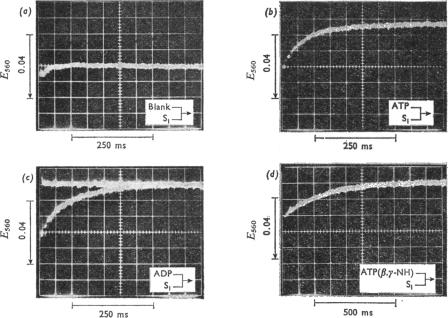
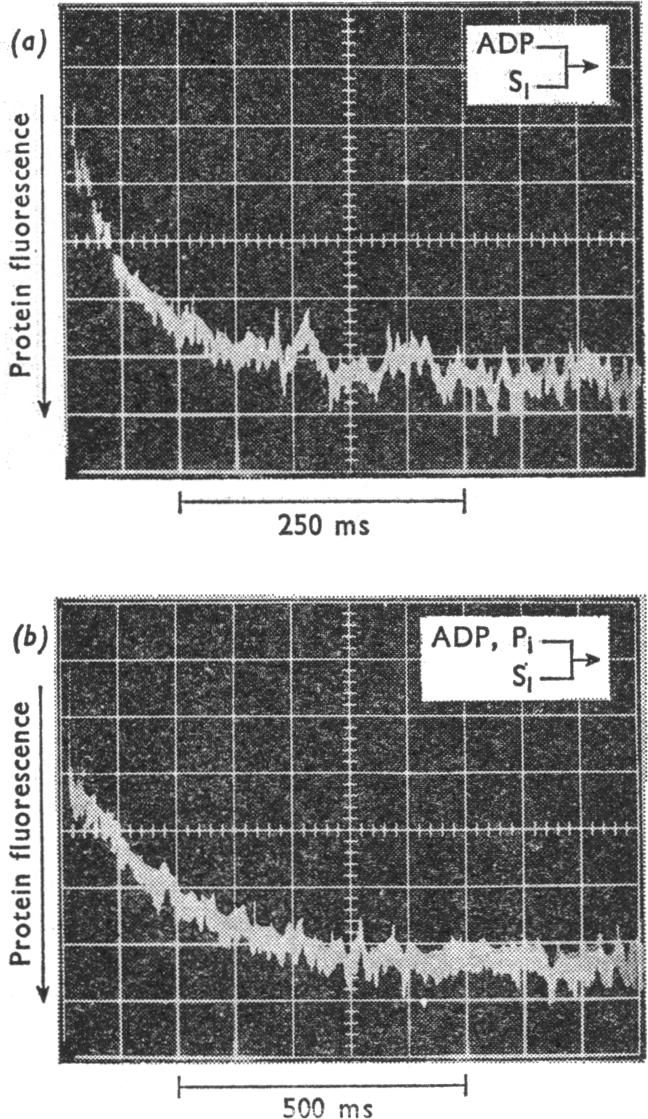
Evidence is presented that the myosin subfragment-1-ADP complex, generated by the addition of Mg(2+) and ADP to subfragment 1, is an intermediate within the myosin Mg(2+)-dependent adenosine triphosphatase (ATPase) turnover cycle. The existence of this species as a steady-state intermediate at pH8 and 5 degrees C is demonstrated by fluorescence measurements, but its concentration becomes too low to measure at 21 degrees C. This arises because there is a marked temperature-dependence on the rate of the process controlling ADP dissociation from subfragment 1 (rate=1.4s(-1) at 21 degrees C, 0.07s(-1) at 5 degrees C). In the ATPase pathway this reaction is in series with a relatively temperature-insensitive process, namely an isomerization of the subfragment-1-product complex (rate=0.055s(-1) at 21 degrees C, 0.036s(-1) at 5 degrees C). By means of studies on the P(i) inhibition of nucleotide-association rates, a myosin subfragment-1-P(i) complex was characterized with a dissociation equilibrium constant of 1.5mm. P(i) appears to bind more weakly to the myosin subfragment-1-ADP complex. The studies indicate that P(i) dissociates from subfragment 1 at a rate greater than 40s(-1), and substantiates the existence of a myosin-product isomerization before product release in the elementary processes of the Mg(2+)-dependent ATPase. In this ATPase mechanism Mg(2+) associates as a complex with ATP and is released as a complex with ADP. In 0.1m-KCl at pH8 1.0mol of H(+) is released/mol of subfragment 1 concomitant with the myosin-product isomerization or P(i) dissociation, and 0.23 mol of H(+) is released/mol of subfragment when ATP binds to the protein, but 0.23 mol of H(+) is taken up again from the medium when ADP dissociates. Within experimental sensitivity no H(+) is released into the medium in the step involving ATP cleavage.
有证据表明,通过向肌球蛋白亚片段1添加Mg(2+)和ADP所生成的肌球蛋白亚片段1-ADP复合物,是肌球蛋白Mg(2+)依赖性腺苷三磷酸酶(ATP酶)周转循环中的一个中间体。通过荧光测量证明了该物种在pH8和5℃时作为稳态中间体存在,但其浓度在21℃时变得过低而无法测量。这是因为控制ADP从亚片段1解离的过程速率具有明显的温度依赖性(21℃时速率为1.4s(-1),5℃时为0.07s(-1))。在ATP酶途径中,该反应与一个相对温度不敏感的过程串联,即亚片段1-产物复合物的异构化(21℃时速率为0.055s(-1),5℃时为0.036s(-1))。通过对Pi对核苷酸结合速率的抑制作用的研究,表征了一种肌球蛋白亚片段1-Pi复合物,其解离平衡常数为1.5mM。Pi似乎与肌球蛋白亚片段1-ADP复合物的结合较弱。研究表明,Pi以大于40s(-1)的速率从亚片段1解离,并证实了在Mg(2+)依赖性ATP酶的基本过程中,在产物释放之前存在肌球蛋白-产物异构化。在这种ATP酶机制中,Mg(2+)作为与ATP的复合物结合,并作为与ADP的复合物释放。在pH8的0.1m-KCl中,每摩尔亚片段1伴随着肌球蛋白-产物异构化或Pi解离释放1.0摩尔H(+),当ATP与蛋白质结合时,每摩尔亚片段释放0.23摩尔H(+),但当ADP解离时,又从介质中重新摄取0.23摩尔H(+)。在实验灵敏度范围内,在涉及ATP裂解的步骤中没有H(+)释放到介质中。