Department of Anatomy and Cell Biology, University of Iowa, Iowa City, IA.
Institute of Vegetative Physiology, University of Köln, Köln, Germany.
J Gen Physiol. 2021 Mar 1;153(3). doi: 10.1085/jgp.202012755.
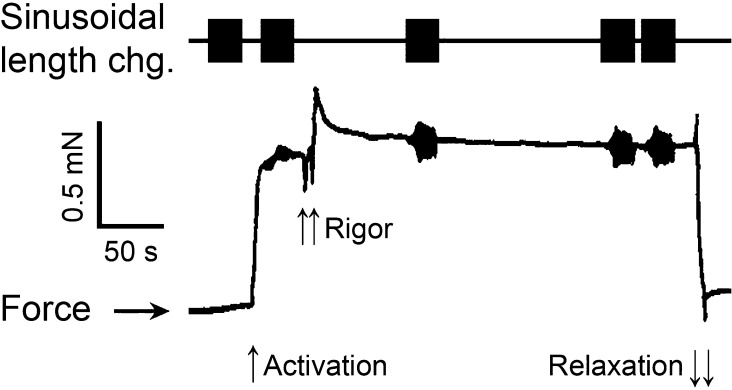
In this study, we aimed to study the role of inorganic phosphate (Pi) in the production of oscillatory work and cross-bridge (CB) kinetics of striated muscle. We applied small-amplitude sinusoidal length oscillations to rabbit psoas single myofibrils and muscle fibers, and the resulting force responses were analyzed during maximal Ca2+ activation (pCa 4.65) at 15°C. Three exponential processes, A, B, and C, were identified from the tension transients, which were studied as functions of Pi concentration ([Pi]). In myofibrils, we found that process C, corresponding to phase 2 of step analysis during isometric contraction, is almost a perfect single exponential function compared with skinned fibers, which exhibit distributed rate constants, as described previously. The [Pi] dependence of the apparent rate constants 2πb and 2πc, and that of isometric tension, was studied to characterize the force generation and Pi release steps in the CB cycle, as well as the inhibitory effect of Pi. In contrast to skinned fibers, Pi does not accumulate in the core of myofibrils, allowing sinusoidal analysis to be performed nearly at [Pi] = 0. Process B disappeared as [Pi] approached 0 mM in myofibrils, indicating the significance of the role of Pi rebinding to CBs in the production of oscillatory work (process B). Our results also suggest that Pi competitively inhibits ATP binding to CBs, with an inhibitory dissociation constant of ∼2.6 mM. Finally, we found that the sinusoidal waveform of tension is mostly distorted by second harmonics and that this distortion is closely correlated with production of oscillatory work, indicating that the mechanism of generating force is intrinsically nonlinear. A nonlinear force generation mechanism suggests that the length-dependent intrinsic rate constant is asymmetric upon stretch and release and that there may be a ratchet mechanism involved in the CB cycle.
在这项研究中,我们旨在研究无机磷酸盐(Pi)在产生横纹肌的振荡功和横桥(CB)动力学中的作用。我们对兔腰大肌的单个肌原纤维和肌纤维施加小振幅正弦长度振荡,并在 15°C 时最大 Ca2+激活(pCa4.65)下分析产生的力响应。从张力瞬变中识别出三个指数过程 A、B 和 C,研究了它们与 Pi 浓度([Pi])的关系。在肌原纤维中,我们发现与等长收缩期间阶跃分析的相位 2 相对应的过程 C 几乎是一个完美的单指数函数,而与之前描述的去垢纤维相比,去垢纤维表现出分布的速率常数。研究了表观速率常数 2πb 和 2πc 以及等长张力的[Pi]依赖性,以表征 CB 循环中的力产生和 Pi 释放步骤,以及 Pi 的抑制作用。与去垢纤维不同,Pi 不会在肌原纤维的核心中积累,从而可以在几乎[Pi]=0 时进行正弦分析。在肌原纤维中,当[Pi]接近 0mM 时,过程 B 消失,表明 Pi 重新结合到 CB 上在产生振荡功(过程 B)中的作用显著。我们的结果还表明,Pi 竞争性抑制 CB 与 ATP 的结合,抑制解离常数约为 2.6mM。最后,我们发现张力的正弦波形主要被二次谐波扭曲,这种扭曲与产生振荡功密切相关,表明产生力的机制本质上是非线性的。非线性力产生机制表明,在拉伸和释放时,长度依赖性固有速率常数是不对称的,并且 CB 循环中可能涉及棘轮机制。