Mountcastle W E, Compans R W, Caliguiri L A, Choppin P W
J Virol. 1970 Nov;6(5):677-84. doi: 10.1128/JVI.6.5.677-684.1970.
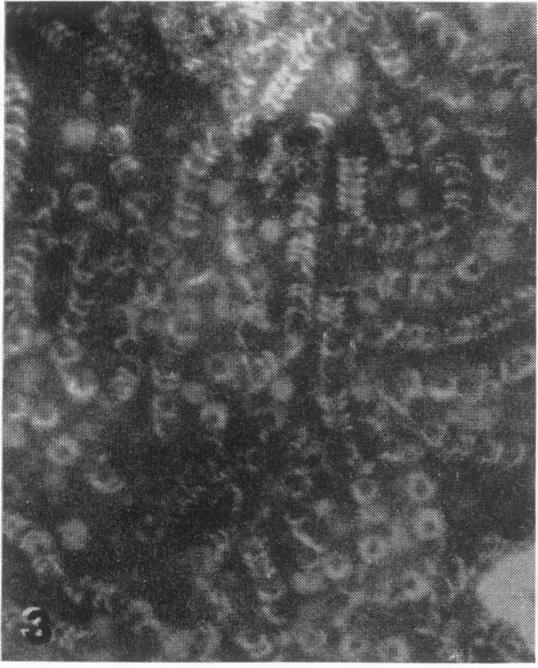
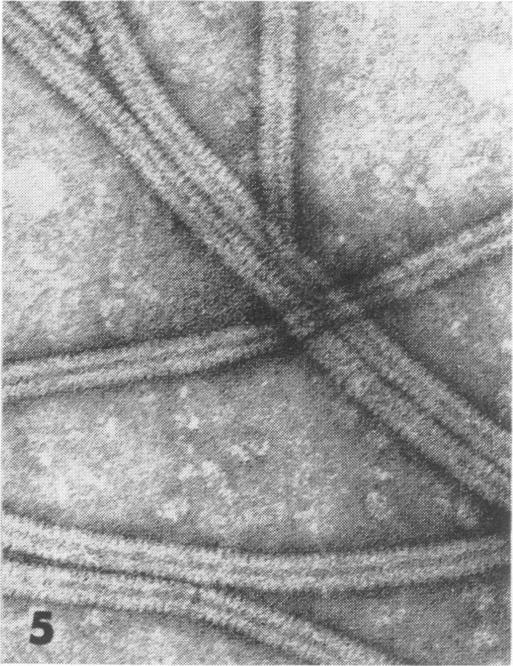
Helical nucleocapsids of each of the paramyxoviruses simian virus 5 (SV5), Newcastle disease virus (NDV), and Sendai virus have been isolated in two different forms. One form contains larger protein subunits and is obtained from mature virions or infected cells dispersed by ethylenediaminetetraacetic acid. The other form possesses smaller subunits and is obtained from infected cells dispersed by trypsin. The estimated molecular weights of the larger subunits in the three viruses are similar: SV5, 61,000; Sendai virus, 60,000; NDV, 56,000. The smaller nucleocapsid subunits are also very similar: SV5, 43,000; Sendai virus, 46,000; NDV, 47,000. The helical nucleocapsid composed of the smaller subunit appears to be less flexible and more stable than that formed by the larger subunit. There is suggestive evidence that conversion of the larger subunit to the smaller by proteolytic cleavage may occur intracellularly. The possibility that such a mechanism could be involved in the accumulation of nucleocapsid in cells persistently infected with paramyxoviruses is discussed.
副粘病毒猴病毒5(SV5)、新城疫病毒(NDV)和仙台病毒的螺旋核衣壳已以两种不同形式分离出来。一种形式含有较大的蛋白质亚基,是从成熟病毒粒子或经乙二胺四乙酸分散的感染细胞中获得的。另一种形式具有较小的亚基,是从经胰蛋白酶分散的感染细胞中获得的。三种病毒中较大亚基的估计分子量相似:SV5为61,000;仙台病毒为60,000;NDV为56,000。较小的核衣壳亚基也非常相似:SV5为43,000;仙台病毒为46,000;NDV为47,000。由较小亚基组成的螺旋核衣壳似乎比较大亚基形成的核衣壳更不灵活且更稳定。有暗示性证据表明,较大亚基通过蛋白水解裂解转化为较小亚基可能发生在细胞内。本文讨论了这种机制可能参与副粘病毒持续感染细胞中核衣壳积累的可能性。