Mechanism of action of superoxide dismutase from pulse radiolysis and electron paramagnetic resonance. Evidence that only half the active sites function in catalysis.
作者信息
Fielden E M, Roberts P B, Bray R C, Lowe D J, Mautner G N, Rotilio G, Calabrese L
出版信息
Biochem J. 1974 Apr;139(1):49-60. doi: 10.1042/bj1390049.
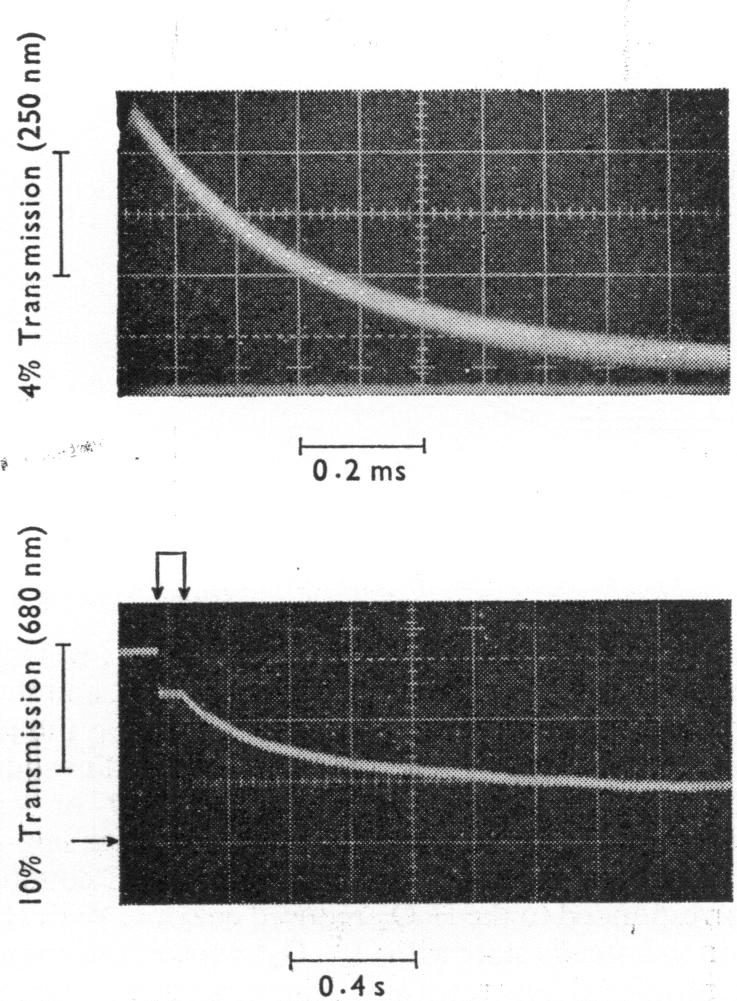
Detailed studies on the mechanism of the enzymic reaction of bovine superoxide dismutase were carried out by using pulse radiolysis and electron paramagnetic resonance (e.p.r.). 2. The second-order rate constant for reaction between superoxide dismutase and the superoxide ion was redetermined as (2.37+/-0.18)x10(9)m(-1).s(-1) at 25 degrees C. This reaction governs the turnover, and any first-order steps must have rate constants higher than about 10(6)s(-1). Turnover has a low activation energy and is slowed substantially when the viscosity is increased with glycerol, confirming that the reaction rate is near the limit for diffusion control. In water a reversible conformation change to a less active form appears to take place above about 40 degrees C. 3. Pre-steady-state rates of reduction and reoxidation of copper in the enzyme are consistent with these processes being rate-limiting in enzyme turnover. 4. Examination, with the help of computer simulation, of the e.p.r. spectra at 9 and 35GHz of native superoxide dismutase indicated that, apart from 10-20% of impurities, only one species of Cu(2+) is distinguishable. Further, the specific activity of our enzyme preparations, measured by pulse radiolysis, is at least as high as that obtained by other workers. 5. Nevertheless, measurement of the proportion of copper present as Cu(2+) (determined both optically and by e.p.r. spectroscopy) in the steady states approached from both the oxidized and the reduced forms of the enzyme, indicates (after allowing for the impurities) that only half of the copper atoms participate in turnover. E.p.r. spectroscopy provided no evidence for differences between functioning and non-functioning Cu(2+) atoms. 6. It is suggested that the results may be best interpreted in terms of an allosteric type of mechanism, with two initially indistinguishable copper atoms in the enzyme. Reaction of one of these with a superoxide ion then renders the other, at least transiently, unreactive.