Carballal Sebastián, Bartesaghi Silvina, Radi Rafael
Departamento de Bioquímica, Facultad de Medicina, Universidad de la República, Montevideo, Uruguay; Center for Free Radical and Biomedical Research, Facultad de Medicina, Universidad de la República, Montevideo, Uruguay.
Biochim Biophys Acta. 2014 Feb;1840(2):768-80. doi: 10.1016/j.bbagen.2013.07.005. Epub 2013 Jul 18.
Peroxynitrite, the product of the reaction between superoxide radicals and nitric oxide, is an elusive oxidant with a short half-life and a low steady-state concentration in biological systems; it promotes nitroxidative damage.
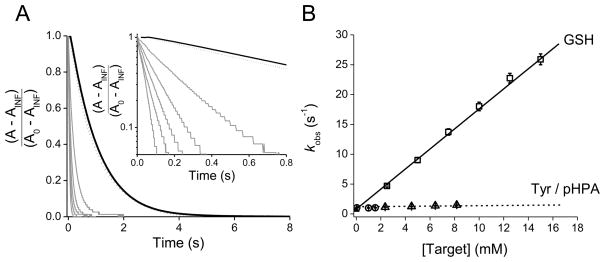
We will consider kinetic and mechanistic aspects that allow rationalizing the biological fate of peroxynitrite from data obtained by a combination of methods that include fast kinetic techniques, electron paramagnetic resonance and kinetic simulations. In addition, we provide a quantitative analysis of peroxynitrite production rates and conceivable steady-state levels in living systems.
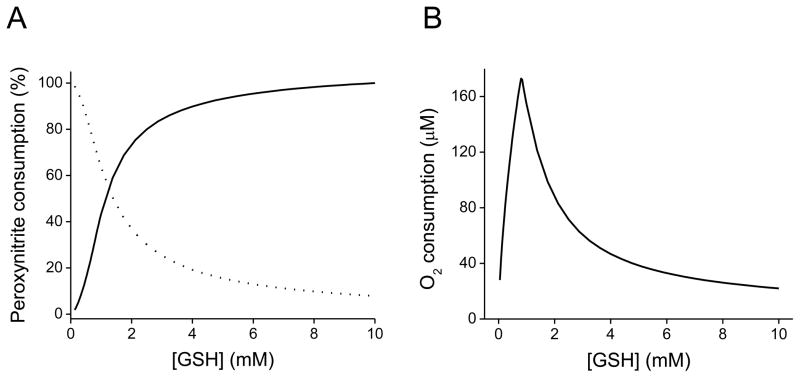
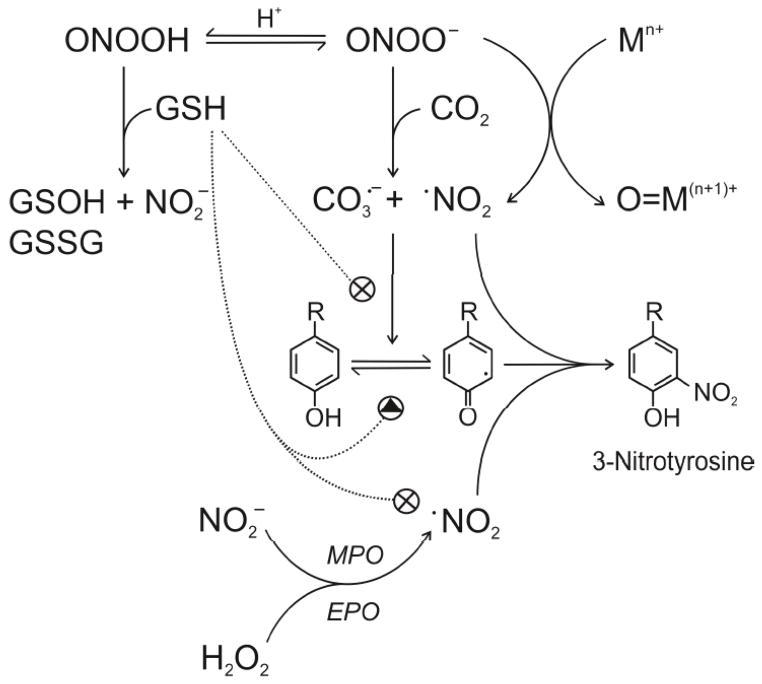
The preferential reactions of peroxynitrite in vivo include those with carbon dioxide, thiols and metalloproteins; its homolysis represents only <1% of its fate. To note, carbon dioxide accounts for a significant fraction of peroxynitrite consumption leading to the formation of strong one-electron oxidants, carbonate radicals and nitrogen dioxide. On the other hand, peroxynitrite is rapidly reduced by peroxiredoxins, which represent efficient thiol-based peroxynitrite detoxification systems. Glutathione, present at mM concentration in cells and frequently considered a direct scavenger of peroxynitrite, does not react sufficiently fast with it in vivo; glutathione mainly inhibits peroxynitrite-dependent processes by reactions with secondary radicals. The detection of protein 3-nitrotyrosine, a molecular footprint, can demonstrate peroxynitrite formation in vivo. Basal peroxynitrite formation rates in cells can be estimated in the order of 0.1 to 0.5μMs(-1) and its steady-state concentration at ~1nM.
The analysis provides a handle to predict the preferential fate and steady-state levels of peroxynitrite in living systems. This is useful to understand pathophysiological aspects and pharmacological prospects connected to peroxynitrite. This article is part of a Special Issue entitled Current methods to study reactive oxygen species - pros and cons and biophysics of membrane proteins. Guest Editor: Christine Winterbourn.
过氧亚硝酸根是超氧自由基与一氧化氮反应的产物,是一种难以捉摸的氧化剂,在生物系统中半衰期短且稳态浓度低;它会促进氮氧化损伤。
我们将探讨动力学和机制方面的内容,以便根据通过包括快速动力学技术、电子顺磁共振和动力学模拟等多种方法组合获得的数据,使过氧亚硝酸根的生物学命运合理化。此外,我们对过氧亚硝酸根在生物系统中的生成速率和可能的稳态水平进行了定量分析。
过氧亚硝酸根在体内的优先反应包括与二氧化碳、硫醇和金属蛋白的反应;其均裂仅占其反应命运的不到1%。需要注意的是,二氧化碳占过氧亚硝酸根消耗的很大一部分,导致形成强单电子氧化剂、碳酸根自由基和二氧化氮。另一方面,过氧亚硝酸根会被过氧化物酶迅速还原,过氧化物酶是高效的基于硫醇的过氧亚硝酸根解毒系统。细胞内浓度为毫摩尔级的谷胱甘肽,通常被认为是过氧亚硝酸根的直接清除剂,但在体内与过氧亚硝酸根的反应不够快;谷胱甘肽主要通过与次级自由基反应来抑制过氧亚硝酸根依赖性过程。蛋白质3 - 硝基酪氨酸(一种分子印记)的检测可以证明体内过氧亚硝酸根的形成。细胞内过氧亚硝酸根的基础生成速率估计约为0.1至0.5μMs(-1),其稳态浓度约为1nM。
该分析为预测过氧亚硝酸根在生物系统中的优先命运和稳态水平提供了一种方法。这有助于理解与过氧亚硝酸根相关的病理生理方面和药理学前景。本文是名为“研究活性氧物种的当前方法——利弊与膜蛋白生物物理学”的特刊的一部分。客座编辑:克里斯汀·温特伯恩。