Levitt M D, Levitt D G
J Clin Invest. 1973 Aug;52(8):1852-62. doi: 10.1172/JCI107368.
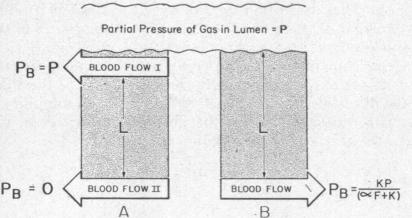
Measurement of the relative absorption rates of inert gases (H(2), He, CH(4), SF(6), and (133)Xe) was used to investigate the interaction between diffusion and blood flow during passive absorption from the stomach, small bowel, and colon of the rat. If uptake is blood flow limited, the gases should be absorbed in proportion to their solubilities in blood, but if diffusion limited, uptake should be proportional to the diffusion rate of the gases in mucosal tissues. The observed absorption data were fitted to a series of models of interaction between perfusion and diffusion. A simple model accurately predicted the absorption rates of the gases from all segments of bowel. In this model, gas is absorbed into two distinct blood flows: one which flows in proximity to the lumen and completely equilibrates with the lumen, and a second which is sufficiently rapid and distant from the lumen that its gas uptake is entirely diffusion limited. The fraction of the total absorption attributable to the equilibrating flow can be readily calculated and equalled 93%, 77%, and 33% for the small bowel, colon, and stomach, respectively. Thus the rate of passive absorption of gases from the small bowel is limited almost entirely by the blood flow to the mucosa, and absorption from the stomach is largely limited by the diffusion rate of the gases. The flow which equilibrates with the lumen can be quantitated, and this flow may provide a useful measure of "effective" mucosal blood flow.
通过测量惰性气体(氢气、氦气、甲烷、六氟化硫和氙-133)的相对吸收率,研究大鼠胃、小肠和结肠被动吸收过程中扩散与血流之间的相互作用。如果吸收受血流限制,气体的吸收应与其在血液中的溶解度成正比,但如果受扩散限制,吸收应与气体在黏膜组织中的扩散速率成正比。将观察到的吸收数据与一系列灌注和扩散相互作用模型进行拟合。一个简单的模型准确预测了气体在肠道各段的吸收率。在该模型中,气体被吸收进入两种不同的血流:一种靠近管腔流动并与管腔完全平衡,另一种速度足够快且远离管腔,其气体吸收完全受扩散限制。可轻松计算出平衡流在总吸收中所占的比例,小肠、结肠和胃的该比例分别为93%、77%和33%。因此,小肠气体的被动吸收速率几乎完全受黏膜血流限制,而胃的吸收很大程度上受气体扩散速率限制。与管腔平衡的血流可以定量,这种血流可能为“有效”黏膜血流提供有用的测量指标。