Sherwin R S, Kramer K J, Tobin J D, Insel P A, Liljenquist J E, Berman M, Andres R
J Clin Invest. 1974 May;53(5):1481-92. doi: 10.1172/JCI107697.
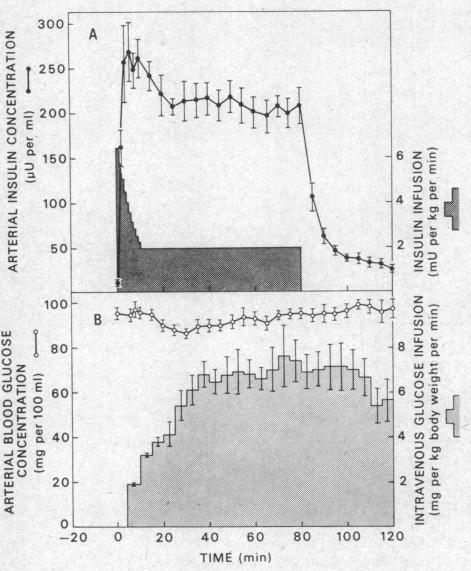
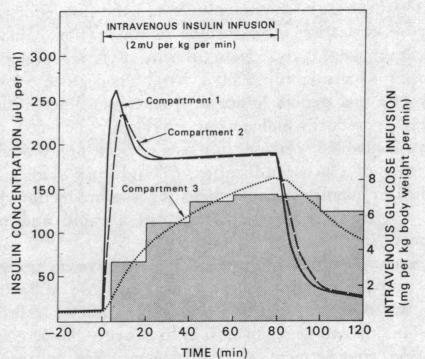
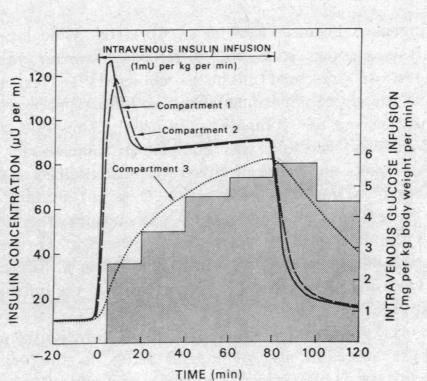
The design of the present study of the kinetics of insulin in man combines experimental features which obviate two of the major problems in previous insulin studies. (a) The use of radioiodinated insulin as a tracer has been shown to be inappropriate since its metabolism differs markedly from that of the native hormone. Therefore porcine insulin was administered by procedures which raised insulin levels in arterial plasma into the upper physiologic range. Hypoglycemia was prevented by adjusting the rate of an intravenous infusion of glucose in order to control the blood glucose concentration (the glucose-clamp technique). (b) Estimation of a single biological half-time of insulin after pulse injection of the hormone has been shown to be inappropriate since plasma insulin disappearance curves are multiexponential. Therefore the SAAM 25 computer program was used in order to define the parameters of a three compartment insulin model. The combined insulin mass of the three compartments (expressed as plasma equivalent volume) is equal to inulin space (15.7% body wt). Compartment 1 is apparently the plasma space (4.5%). The other two compartments are extra-vascular; compartment 2 is small (1.7%) and equilibrates rapidly with plasma, and compartment 3 is large (9.5%) and equilibrates slowly with plasma. The SAAM 25 program can simulate the buildup and decay of insulin in compartments 2 and 3 which cannot be assayed directly. Insulin in compartment 3 was found to correlate remarkably with the time-course of the servo-controlled glucose infusion. Under conditions of a steady-state arterial glucose level, glucose infusion is a measure of glucose utilization. We conclude that compartment 3 insulin (rather than plasma insulin) is a more direct determinant of glucose utilization. We suggest that the combined use of glucose-clamp and kinetic-modeling techniques should aid in the delineation of pathophysiologic states affecting glucose and insulin metabolism.
本项关于人体胰岛素动力学的研究设计结合了一些实验特性,这些特性避免了以往胰岛素研究中的两个主要问题。(a) 已证明使用放射性碘化胰岛素作为示踪剂并不合适,因为其代谢与天然激素的代谢明显不同。因此,通过将动脉血浆中的胰岛素水平提高到生理范围上限的方法来给予猪胰岛素。通过调整静脉输注葡萄糖的速率来预防低血糖,以控制血糖浓度(葡萄糖钳夹技术)。(b) 已证明在脉冲注射激素后估计胰岛素的单一生物学半衰期并不合适,因为血浆胰岛素消失曲线是多指数的。因此,使用SAAM 25计算机程序来定义三室胰岛素模型的参数。三室的联合胰岛素质量(以血浆等效体积表示)等于菊粉空间(体重的15.7%)。室1显然是血浆空间(4.5%)。另外两个室是血管外的;室2较小(1.7%),与血浆快速平衡,室3较大(9.5%),与血浆平衡缓慢。SAAM 25程序可以模拟室2和室3中胰岛素的积累和衰减,而这两个室无法直接检测。发现室3中的胰岛素与伺服控制的葡萄糖输注的时间进程显著相关。在动脉葡萄糖水平稳定的条件下,葡萄糖输注是葡萄糖利用的一种度量。我们得出结论,室3胰岛素(而非血浆胰岛素)是葡萄糖利用的更直接决定因素。我们建议,联合使用葡萄糖钳夹和动力学建模技术应有助于描绘影响葡萄糖和胰岛素代谢的病理生理状态。