Dyer J K, Anderson A W, Dutiyabodhi P
Appl Microbiol. 1966 Jan;14(1):92-7. doi: 10.1128/am.14.1.92-97.1966.
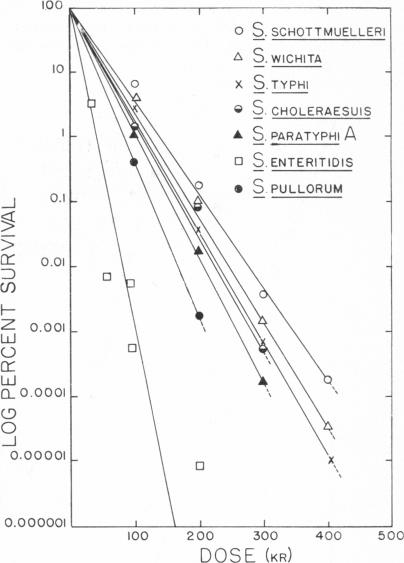
When 15 bacterial species representing genera associated with food-borne diseases were irradiated individually, all except Escherichia coli and Streptococcus faecalis showed typical linear dose-survival curves in Hartsell's broth. The minimal lethal dose (MLD) for the organisms tested ranged from 3.0 x 10(5) to 6.0 x 10(5) rad. Salmonella paratyphi B, S. wichita, S. typhi, E. coli, and S. faecalis were found to be the least sensitive to radiation. In commercially canned crabmeat the survival curves of S. typhi, S. paratyphi B, and S. wichita exhibited to varying degrees an initial linear death decline with increasing radiation doses, followed by a distinct tailing effect caused by survival of low numbers at the higher doses. The above species of Salmonella were further individually subjected to gamma-radiation in various dilutions of crabmeat. The "tailing effect" gradually disappeared, with the dose-survival curve tending to become linear as the concentration of the crabmeat decreased.
当对代表与食源性疾病相关属的15种细菌进行单独辐照时,除大肠杆菌和粪链球菌外,所有细菌在哈茨尔肉汤中均呈现典型的线性剂量-存活曲线。所测试的生物体的最小致死剂量(MLD)范围为3.0×10⁵至6.0×10⁵拉德。副伤寒乙杆菌、威奇托沙门氏菌、伤寒杆菌、大肠杆菌和粪链球菌对辐射最不敏感。在商业罐装蟹肉中,伤寒杆菌、副伤寒乙杆菌和威奇托沙门氏菌的存活曲线在不同程度上呈现出随着辐射剂量增加最初线性死亡下降,随后在较高剂量下因少量存活而产生明显的拖尾效应。上述沙门氏菌种类进一步在蟹肉的各种稀释液中单独接受伽马辐射。随着蟹肉浓度降低,“拖尾效应”逐渐消失,剂量-存活曲线趋于变为线性。