• 文献检索
  • 文档翻译
  • 深度研究
  • 学术资讯
  • Suppr Zotero 插件Zotero 插件
  • 邀请有礼
  • 套餐&价格
  • 历史记录
应用&插件
Suppr Zotero 插件Zotero 插件浏览器插件Mac 客户端Windows 客户端微信小程序
定价
高级版会员购买积分包购买API积分包
服务
文献检索文档翻译深度研究API 文档MCP 服务
关于我们
关于 Suppr公司介绍联系我们用户协议隐私条款
关注我们

Suppr 超能文献

核心技术专利:CN118964589B侵权必究
粤ICP备2023148730 号-1Suppr @ 2026

文献检索

告别复杂PubMed语法,用中文像聊天一样搜索,搜遍4000万医学文献。AI智能推荐,让科研检索更轻松。

立即免费搜索

文件翻译

保留排版,准确专业,支持PDF/Word/PPT等文件格式,支持 12+语言互译。

免费翻译文档

深度研究

AI帮你快速写综述,25分钟生成高质量综述,智能提取关键信息,辅助科研写作。

立即免费体验

短跑的力学原理。

The mechanics of sprint running.

作者信息

Cavagna G A, Komarek L, Mazzoleni S

出版信息

J Physiol. 1971 Sep;217(3):709-21. doi: 10.1113/jphysiol.1971.sp009595.

DOI:10.1113/jphysiol.1971.sp009595
PMID:5098087
原文链接:https://pmc.ncbi.nlm.nih.gov/articles/PMC1331572/
Abstract
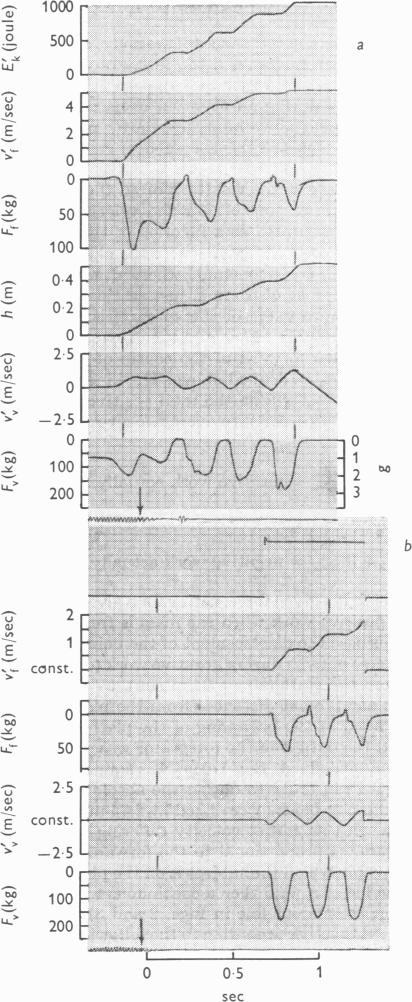
  1. The effect of the velocity of shortening on the power developed by the muscles in sprint running was studied by measuring the mechanical work done to accelerate the body forward from the start to about 34 km/hr.2. The work was measured at each step from the data obtained by means of a platform sensitive to the force impressed by the foot.3. Almost the totality of the positive work done during the first second from the start is found as an increase of the kinetic energy of the body. However, as the speed of the run rises, air resistance and particularly the deceleration of the body forward, taking place at each step, rapidly increase, limiting the speed of the run.4. The average power developed by the muscles during the push at each step increases with the velocity of running reaching 3-4 h.p. at the maximal speed attained.5. At low speed the contractile component of the muscles seems to be mainly responsible for the power output, whereas at high speed (25-34 km/hr) an appreciable fraction of the power appears to be sustained by the mechanical energy stored in the ;series elastic elements' during stretching the contracted muscles (negative work) and released immediately after in the positive work phase.
摘要
  1. 通过测量从起跑开始将身体向前加速至约34公里/小时所做的机械功,研究了短跑中肌肉缩短速度对其产生的功率的影响。

  2. 根据通过对脚部施加的力敏感的平台获得的数据,在每一步测量功。

  3. 从起跑开始的第一秒内所做的正功几乎全部表现为身体动能的增加。然而,随着跑步速度的提高,空气阻力,特别是身体在每一步向前的减速迅速增加,限制了跑步速度。

  4. 每一步蹬地时肌肉产生的平均功率随着跑步速度的增加而增加,在达到的最大速度时达到3 - 4马力。

  5. 在低速时,肌肉的收缩成分似乎是功率输出的主要原因,而在高速(25 - 34公里/小时)时,相当一部分功率似乎由在拉伸收缩肌肉(负功)期间储存在“串联弹性元件”中的机械能维持,并在正功阶段后立即释放。
https://cdn.ncbi.nlm.nih.gov/pmc/blobs/bd48/1331572/6730006f9dac/jphysiol01017-0193-a.jpg

相似文献

1
The mechanics of sprint running.短跑的力学原理。
J Physiol. 1971 Sep;217(3):709-21. doi: 10.1113/jphysiol.1971.sp009595.
2
Mechanical work and efficiency in level walking and running.水平行走和跑步中的机械功与效率。
J Physiol. 1977 Jun;268(2):467--81. doi: 10.1113/jphysiol.1977.sp011866.
3
Optimisation of sprinting performance in running, cycling and speed skating.跑步、自行车和速度滑冰中短跑成绩的优化。
Sports Med. 1994 Apr;17(4):259-75. doi: 10.2165/00007256-199417040-00006.
4
The two power limits conditioning step frequency in human running.人类跑步中两个功率极限调节步频。
J Physiol. 1991 Jun;437:95-108. doi: 10.1113/jphysiol.1991.sp018586.
5
Calf muscle moment, work and efficiency in level walking; role of series elasticity.小腿肌肉力矩、功及在平地行走中的效率;串联弹性的作用。
J Biomech. 1983;16(7):523-37. doi: 10.1016/0021-9290(83)90067-2.
6
Effect of stretching on the elastic characteristics and the contractile component of frog striated muscle.拉伸对青蛙横纹肌弹性特性和收缩成分的影响。
J Physiol. 1974 May;239(1):1-14. doi: 10.1113/jphysiol.1974.sp010552.
7
Energetics and mechanics of terrestrial locomotion. IV. Total mechanical energy changes as a function of speed and body size in birds and mammals.陆地运动的能量学与力学。IV. 鸟类和哺乳动物中总机械能随速度和体型的变化
J Exp Biol. 1982 Apr;97:57-66. doi: 10.1242/jeb.97.1.57.
8
Contributions to the understanding of gait control.对步态控制理解的贡献。
Dan Med J. 2014 Apr;61(4):B4823.
9
The effects of resisted sled-pulling sprint training on acceleration and maximum speed performance.抗阻雪橇拉动冲刺训练对加速和最大速度表现的影响。
J Sports Med Phys Fitness. 2005 Sep;45(3):284-90.
10
The mechanisms for minimizing energy expenditure in human locomotion.人类运动中使能量消耗最小化的机制。
Eur J Clin Nutr. 1990;44 Suppl 1:65-71.

引用本文的文献

1
Quantifying metabolic energy contributions in sprint running: a novel bioenergetic model.量化短跑中的代谢能量贡献:一种新型生物能量模型。
Eur J Appl Physiol. 2025 Jun 19. doi: 10.1007/s00421-025-05831-0.
2
An Exploratory Vector Field Analysis of Ground Reaction Force During Maximum Sprinting Efforts in Male Soccer Players and Sprinters.男子足球运动员和短跑运动员最大冲刺努力时地面反作用力的探索性向量场分析。
Scand J Med Sci Sports. 2024 Nov;34(11):e14763. doi: 10.1111/sms.14763.
3
Energy cost of running uphill as compared to running on the level with impeding horizontal forces.

本文引用的文献

1
Positive work done by a previously stretched muscle.先前拉伸过的肌肉所做的正功。
J Appl Physiol. 1968 Jan;24(1):21-32. doi: 10.1152/jappl.1968.24.1.21.
与在有阻碍水平力的平地上跑步相比,上坡跑步的能量消耗。
Eur J Appl Physiol. 2025 Jan;125(1):61-69. doi: 10.1007/s00421-024-05587-z. Epub 2024 Aug 27.
4
Comparison of Metabolic Power and Energy Cost of Submaximal and Sprint Running Efforts Using Different Methods in Elite Youth Soccer Players: A Novel Energetic Approach.使用不同方法对精英青少年足球运动员次最大强度和冲刺跑运动的代谢功率与能量消耗进行比较:一种新的能量学方法
Sensors (Basel). 2024 Apr 17;24(8):2577. doi: 10.3390/s24082577.
5
Still air resistance during walking and running.步行和跑步时的静止空气阻力。
Proc Biol Sci. 2023 Dec 20;290(2013):20231763. doi: 10.1098/rspb.2023.1763. Epub 2023 Dec 13.
6
Ankle and Plantar Flexor Muscle-Tendon Unit Function in Sprinters: A Narrative Review.短跑运动员的踝关节与跖屈肌-腱单元功能:一篇叙述性综述
Sports Med. 2024 Mar;54(3):585-606. doi: 10.1007/s40279-023-01967-1. Epub 2023 Nov 21.
7
Acceleration-Based Estimation of Vertical Ground Reaction Forces during Running: A Comparison of Methods across Running Speeds, Surfaces, and Foot Strike Patterns.基于加速度的跑步时垂直地面反作用力估计:不同跑步速度、表面和足触地方式下方法的比较。
Sensors (Basel). 2023 Oct 25;23(21):8719. doi: 10.3390/s23218719.
8
Mechanical and Metabolic Power in Accelerated Running-PART I: the 100-m dash.加速跑中的机械和代谢功率——第一部分:100 米短跑。
Eur J Appl Physiol. 2023 Nov;123(11):2473-2481. doi: 10.1007/s00421-023-05236-x. Epub 2023 Jun 10.
9
Recreational runners who recovered from COVID-19 show different running kinetics and muscle activities compared with healthy controls.与健康对照组相比,从 COVID-19 中康复的休闲跑步者表现出不同的跑步动力学和肌肉活动。
Gait Posture. 2022 Jan;91:260-265. doi: 10.1016/j.gaitpost.2021.11.002. Epub 2021 Nov 6.
10
Application of Leg, Vertical, and Joint Stiffness in Running Performance: A Literature Overview.腿部、垂直和关节刚度在跑步表现中的应用:文献综述
Appl Bionics Biomech. 2021 Oct 21;2021:9914278. doi: 10.1155/2021/9914278. eCollection 2021.