
鳟鱼精子发生过程中组蛋白的修饰:改变组蛋白与DNA结合的分子机制。
Modification of histones during spermiogenesis in trout: a molecular mechanism for altering histone binding to DNA.
作者信息
Sung M T, Dixon G H
出版信息
Proc Natl Acad Sci U S A. 1970 Nov;67(3):1616-23. doi: 10.1073/pnas.67.3.1616.
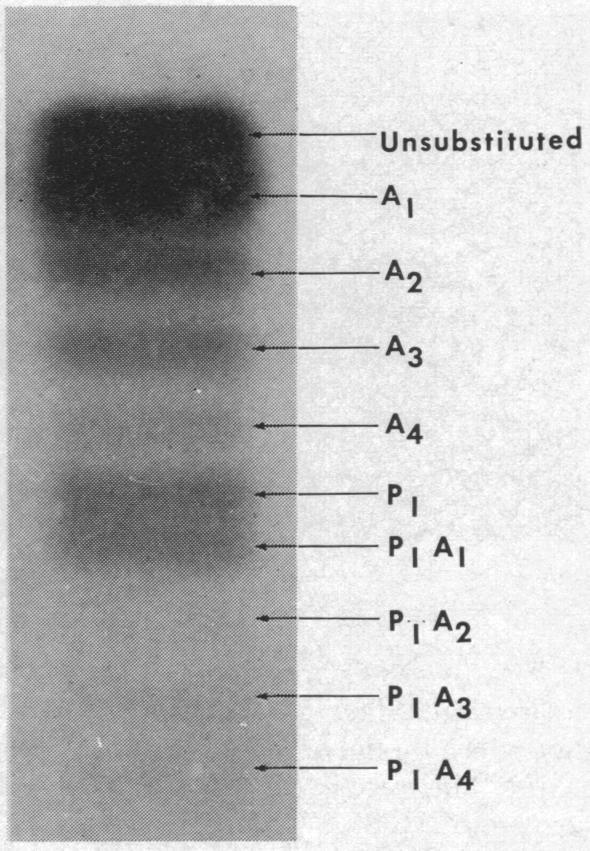
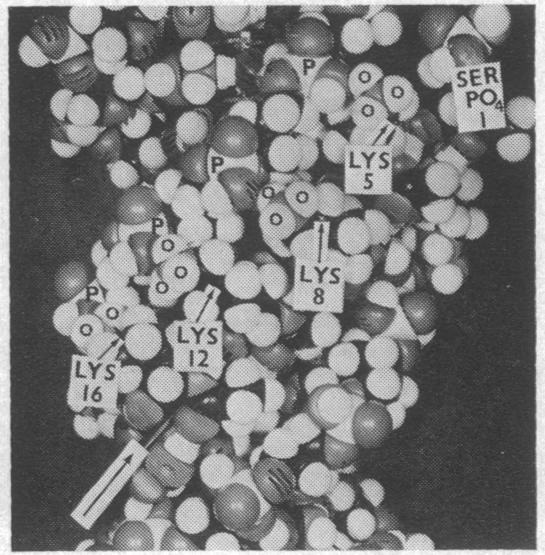
At a late stage of spermatogenesis in rainbow-trout testis, the entire complement of histones is replaced by newly synthesized protamine and histones are extensively phosphorylated and acetylated. Tryptic digestion of purified histones labeled by incubation of testicular cells with [(32)P]phosphate shows that phosphorylation occurs at a small number of seryl residues. Histone I (lysine-rich) is phosphorylated in the sequence Lys-Ser(PO(4))-Pro-Lys, which is located in the lysine-rich C-terminal region of the molecule. Histones IIb(1) (slightly lysine-rich) and IV (glycine, arginine-rich) give rise to the same phosphopeptide, Ac-Ser(PO(4))-Gly-Arg, which comprises the amino terminus of each histone. Thermolysin digests of phosphohistones IIb(1) and IV also released a phosphopeptide with composition corresponding to the first six residues of histone IV: Ac-Ser(PO(4))-Gly-Arg-Gly-Lys-Gly. An alpha-helical model of the N-terminal region of histone IV shows that this region is a possible DNA-binding site. Phosphorylation at serine 1 together with epsilon-amino acetylation at lysines 5, 8, 12, and 16 (observed in histone IV from trout testis) could profoundly modify ionic interactions and lead to an "unzipping" of histone IV from DNA
在虹鳟鱼睾丸精子发生的后期,所有组蛋白被新合成的鱼精蛋白取代,组蛋白发生广泛的磷酸化和乙酰化。用[(32)P]磷酸盐孵育睾丸细胞标记纯化的组蛋白,胰蛋白酶消化显示磷酸化发生在少数丝氨酸残基上。组蛋白I(富含赖氨酸)在分子富含赖氨酸的C末端区域的Lys-Ser(PO4)-Pro-Lys序列中被磷酸化。组蛋白IIb(1)(略富含赖氨酸)和IV(富含甘氨酸、精氨酸)产生相同的磷酸肽Ac-Ser(PO4)-Gly-Arg,其包含每个组蛋白的氨基末端。磷酸化组蛋白IIb(1)和IV的嗜热菌蛋白酶消化也释放出一种磷酸肽,其组成对应于组蛋白IV的前六个残基:Ac-Ser(PO4)-Gly-Arg-Gly-Lys-Gly。组蛋白IV N末端区域的α-螺旋模型表明该区域是一个可能的DNA结合位点。丝氨酸1处的磷酸化以及赖氨酸5、8、12和16处的ε-氨基乙酰化(在虹鳟鱼睾丸的组蛋白IV中观察到)可能会深刻改变离子相互作用,并导致组蛋白IV从DNA上“解开”


 Zotero 插件