Hinrichs W A, Smyth D G
Immunology. 1970 May;18(5):759-67.
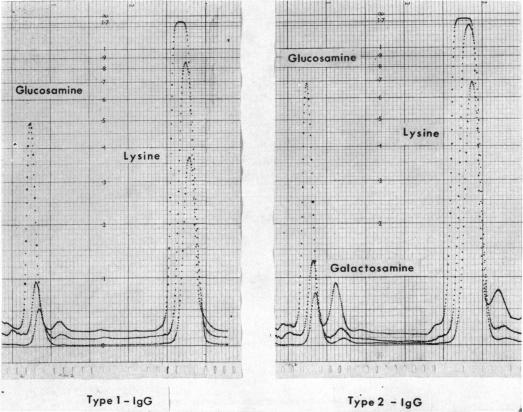
Two populations of IgG molecules have been isolated from rabbit serum: Type 1, which is devoid of C-oligosaccharide, and Type II, which has the C-oligosaccharide attached to only one of the H-chains (Fanger & Smyth, 1970b). By labelling with different isotopes, it was possible to study the stability of the two IgG Types and ; conclusions could then be drawn concerning biosynthesis of the carbohydrate moiety. The C-oligosaccharide is not affixed to or deleted from the IgG molecule during its life span in the circulation; carbohydrate attachment takes place exclusively within the biosynthetic cell. Furthermore, a symmetrical molecule with the C-oligosaccharide on both H-chains does not appear to be formed , although this molecule could easily be formed . It follows that the order of events in biosynthesis of IgG is that first the polypeptide chains are assembled and then the carbohydrate moiety is added to complete the molecule. No exchange of half molecules takes place between different IgG molecules in the serum but this exchange could be induced under mild conditions. Thus after secretion from the cell the IgG molecule retains its structural integrity, both with regard to its constituent polypeptide chains and to its characteristic complement of oligosaccharides.
已从兔血清中分离出两类IgG分子:I型,不含C-寡糖;II型,其C-寡糖仅连接在一条重链上(Fanger和Smyth,1970b)。通过用不同的同位素进行标记,有可能研究这两类IgG的稳定性,进而得出关于碳水化合物部分生物合成的结论。在IgG分子的循环寿命期间,C-寡糖既不会附着到IgG分子上,也不会从其上删除;碳水化合物的附着仅发生在生物合成细胞内。此外,虽然这种分子很容易形成,但似乎不会形成两条重链上都带有C-寡糖的对称分子。由此可见,IgG生物合成过程中事件的顺序是,首先组装多肽链,然后添加碳水化合物部分以完成分子的合成。血清中不同IgG分子之间不会发生半分子的交换,但在温和条件下可以诱导这种交换。因此,从细胞分泌后,IgG分子在其组成多肽链以及寡糖的特征性组成方面都保持其结构完整性。