Gage J C
Br J Ind Med. 1968 Oct;25(4):304-14. doi: 10.1136/oem.25.4.304.
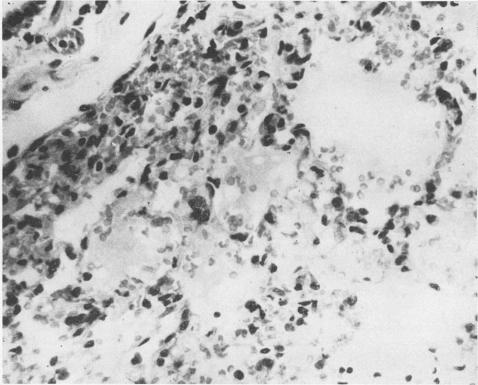
The toxicity of paraquat and diquat aerosols to several species has been investigated. In order to obtain an atmosphere of `respirable' particles, an atomizer has been constructed with an upper cut-off of size by a cyclone separator, and with a calibrated reservoir to enable the concentration output to be estimated by inspection. Paraquat has an irritant action on the lungs, and at lethal concentrations death is delayed and is associated with pulmonary haemorrhage and oedema. After single exposures the LC appears to be a function of the duration and of the concentration; in the rat the lethal concentration-time product (CT) is about 6 μg./l.hr. Guinea-pigs and male mice are about as sensitive as rats. Female mice and rabbits are less sensitive. The dog can tolerate a CT product of 25 μg./l. hr without ill-effects. The toxicity is a complex function of particle size. In the rat it appears that the most effective size is in the region of 3 μ, as larger particles do not reach the alveolar regions and finer particles are probably not retained there. Repeated daily 6-hr exposures of rats to paraquat aerosols over a three-week period produce signs of lung irritation but no deaths at 0·4 μg./l., and the no-effect level is about 0·1 μg./litre. Paraquat appears to be poorly absorbed from the lungs. After single exposures death is associated with a paraquat content of about 6 μg. in the lungs. Paraquat is subsequently cleared from the lung with a half-life of about 36 hr. Diquat is much less irritant to the lungs than is paraquat; the no-effect levels on single and repeated exposure are at least five times larger. It is concluded that paraquat and diquat do not present an inhalation hazard under normal conditions of application, but with paraquat under abnormal conditions it may be desirable to provide respiratory protection.
已对百草枯和敌草快气雾剂对几种物种的毒性进行了研究。为了获得“可吸入”颗粒的大气环境,构建了一种雾化器,其上限粒径由旋风分离器控制,并设有校准储液器,以便通过检查估算浓度输出。百草枯对肺部有刺激作用,在致死浓度下,死亡会延迟,且与肺出血和水肿有关。单次接触后,致死浓度似乎是持续时间和浓度的函数;在大鼠中,致死浓度-时间乘积(CT)约为6微克/升·小时。豚鼠和雄性小鼠与大鼠的敏感性大致相同。雌性小鼠和兔子较不敏感。狗能耐受25微克/升·小时的CT乘积而无不良影响。毒性是粒径的复杂函数。在大鼠中,似乎最有效的粒径在3微米左右,因为较大的颗粒无法到达肺泡区域,而较细的颗粒可能无法在那里滞留。在三周内,大鼠每天重复6小时接触百草枯气雾剂,在0.4微克/升时会产生肺部刺激迹象,但无死亡情况,无影响水平约为0.1微克/升。百草枯似乎从肺部吸收不良。单次接触后,死亡与肺部约6微克的百草枯含量有关。百草枯随后以约36小时的半衰期从肺部清除。敌草快对肺部的刺激性远小于百草枯;单次和重复接触的无影响水平至少大五倍。得出的结论是,在正常使用条件下,百草枯和敌草快不存在吸入危害,但在异常条件下使用百草枯时,可能需要提供呼吸防护。