Thompson T, Sturm T
J Exp Anal Behav. 1965 Nov;8(6):397-403. doi: 10.1901/jeab.1965.8-397.
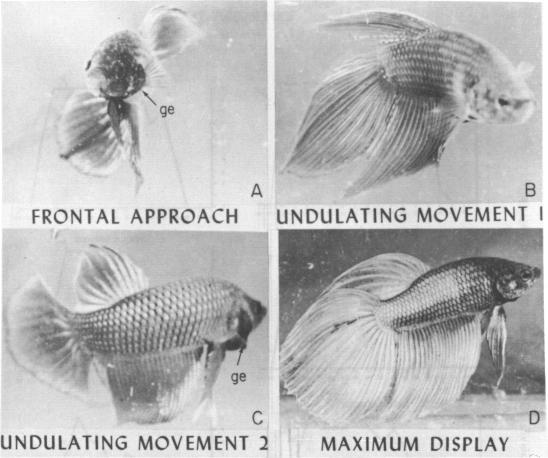
Unconditioned aggressive-display behavior elicited by the mirror image of a male Siamese Fighting Fish was brought under the control of a previously ineffective stimulus by classical conditioning. A stimulus light repeatedly paired with mirror presentation came to elicit the complex aggressive-behavior sequence. Relative rates of acquisition of four components of the display were compared. Fin erection and undulating movements were acquired most rapidly while gill-cover erection and frontal approach were acquired most slowly. A discriminative conditioning procedure revealed that the response was specifically elicited by the conditioned stimulus, and not a sensitization artifact.
暹罗斗鱼雄鱼的镜像引发的无条件攻击展示行为,通过经典条件作用,被置于先前无效刺激的控制之下。一个与镜子呈现反复配对的刺激光开始引发复杂的攻击行为序列。比较了展示的四个组成部分的相对习得率。鳍竖起和波动运动习得最快,而鳃盖竖起和正面接近习得最慢。一个辨别性条件作用程序表明,该反应是由条件刺激特异性引发的,而不是一种敏感化假象。