Etkind P R, Sarkar N H
J Virol. 1983 Jan;45(1):114-23. doi: 10.1128/JVI.45.1.114-123.1983.
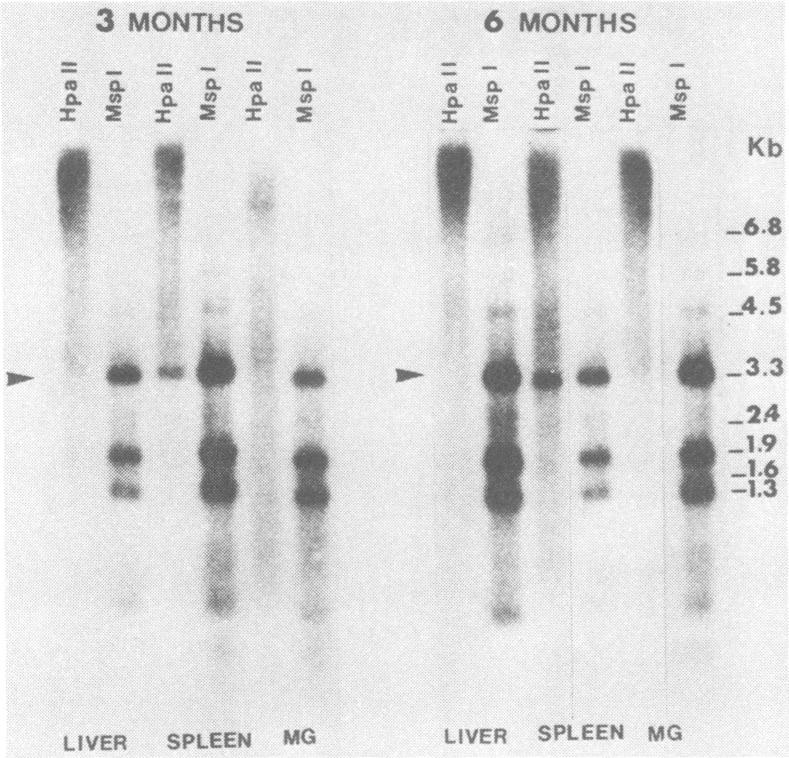
To understand the molecular mechanisms by which the endogenous murine mammary tumor virus (MuMTV) proviruses are expressed and produce late-occurring mammary tumors in C3Hf mice, we analyzed, by the use of restriction enzymes and the Southern transfer procedure, genomic DNA from normal organs of mammary tumor-bearing and tumor-free mice and from 12 late-occurring C3Hf mammary tumors. We found, by using the restriction enzymes EcoRI and HindIII, that in addition to the preexisting endogenous MuMTV proviruses, new MuMTV-specific proviral DNA was integrated into new sites in the host genome in all 12 of the tumors that we examined. PstI digests of C3Hf tumor DNA revealed that the new proviral DNA found in C3Hf tumors was of endogenous origin. Moreover, the respective sizes of at least one of the new DNA fragments generated by EcoRI or HindIII digestion were the same in at least 50% of the C3Hf tumors analyzed, suggesting that the integration site of this new proviral DNA could be at the same location in the host genome of these tumors. Our results may imply that mammary tumorigenesis in C3Hf mice results from activation of cellular oncogenes by an MuMTV proviral DNA promoter. Specific hypomethylation of MuMTV proviral DNA was detected in the mammary tumors and spleens of C3Hf tumor-bearing mice. Our results indicated that most, if not all, of the hypomethylated MuMTV proviral DNA sequences were derived from the endogenous MuMTV provirus located at the MTV-1 locus, a locus responsible for the production of MuMTV antigens and increased incidence of mammary carcinoma in C3Hf mice. In spleens of non-tumor-bearing mice of ages 3, 6, 9, and 12 months, there was progressive hypomethylation of proviral DNA with increasing age, suggesting a possible correlation between demethylation of MuMTV proviral DNA in the spleens of C3Hf mice and the expression of endogenous MuMTV.
为了解内源性鼠乳腺肿瘤病毒(MuMTV)前病毒在C3Hf小鼠中表达并引发晚期乳腺肿瘤的分子机制,我们使用限制性内切酶和Southern印迹法,分析了荷瘤和无瘤小鼠正常器官以及12例晚期C3Hf乳腺肿瘤的基因组DNA。我们发现,使用限制性内切酶EcoRI和HindIII时,除了原有的内源性MuMTV前病毒外,在我们检测的所有12个肿瘤中,新的MuMTV特异性前病毒DNA整合到了宿主基因组的新位点。C3Hf肿瘤DNA的PstI酶切显示,在C3Hf肿瘤中发现的新前病毒DNA源自内源性。此外,在至少50%的分析C3Hf肿瘤中,EcoRI或HindIII酶切产生的至少一个新DNA片段的各自大小相同,这表明这种新前病毒DNA的整合位点可能在这些肿瘤宿主基因组的同一位置。我们的结果可能意味着C3Hf小鼠的乳腺肿瘤发生是由MuMTV前病毒DNA启动子激活细胞癌基因所致。在荷瘤C3Hf小鼠的乳腺肿瘤和脾脏中检测到了MuMTV前病毒DNA的特异性低甲基化。我们的结果表明,大多数(如果不是全部)低甲基化的MuMTV前病毒DNA序列源自位于MTV-1位点的内源性MuMTV前病毒,该位点负责MuMTV抗原的产生以及C3Hf小鼠乳腺癌发病率的增加。在3、