Copeland N G, Bedigian H G, Thomas C Y, Jenkins N A
J Virol. 1984 Feb;49(2):437-44. doi: 10.1128/JVI.49.2.437-444.1984.
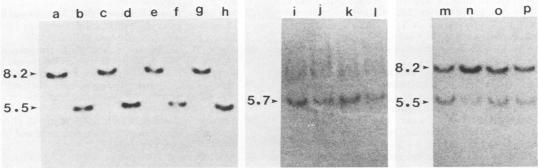
Endogenous ecotropic murine leukemia virus expression varies with inbred mouse strain and age. The mechanism(s) regulating virus expression is unknown, but expression is thought to be controlled at the transcriptional level by linkage to cis-acting cellular DNA sequences or DNA methylation or both. To begin to differentiate between these different control mechanisms, we molecularly cloned two endogenous ecotropic proviruses, Emv-3 and Emv-13, complete with flanking cellular DNA sequences. Both proviruses are poorly expressed in vivo and in vitro, although they appear to be structurally nondefective by restriction enzyme analysis. Cloned DNAs of both proviruses were poorly infectious in DNA transfection experiments, suggesting that methylation may not regulate the expression of these genes in vivo. Removal of their flanking cellular sequences did not increase their infectivity. However, these DNAs were highly infectious when mixed together, indicating that both proviruses carry mutations, that inhibit their expression and belong to different complementation groups. Marker rescue experiments suggested that Emv-3 is defective in the gag region and Emv-13 is defective in p15E-U3. The infectivity of Emv-3, but not of Emv-13, DNA was increased by the addition of AKR xenotropic murine leukemia virus DNA, consistent with known regions of homology between ecotropic and xenotropic proviruses. Recombination between defective endogenous viruses also appears to occur in vivo, suggesting that this may be a common mechanism controlling endogenous murine leukemia virus expression.
内源性嗜亲性鼠白血病病毒的表达随近交系小鼠品系和年龄而变化。调节病毒表达的机制尚不清楚,但认为表达是通过与顺式作用细胞DNA序列或DNA甲基化或两者的连锁在转录水平上受到控制。为了开始区分这些不同的控制机制,我们分子克隆了两个内源性嗜亲性前病毒,Emv - 3和Emv - 13,并带有侧翼细胞DNA序列。尽管通过限制性内切酶分析它们在结构上似乎无缺陷,但这两种前病毒在体内和体外的表达都很差。在DNA转染实验中,两种前病毒的克隆DNA感染性都很差,这表明甲基化可能在体内不调节这些基因的表达。去除它们的侧翼细胞序列并没有增加它们的感染性。然而,当将这些DNA混合在一起时,它们具有高度感染性,这表明两种前病毒都携带抑制其表达的突变,并且属于不同的互补群。标记拯救实验表明,Emv - 3在gag区域有缺陷,Emv - 13在p15E - U3有缺陷。添加AKR异嗜性鼠白血病病毒DNA可增加Emv - 3而非Emv - 13 DNA的感染性,这与嗜亲性和异嗜性前病毒之间已知的同源区域一致。有缺陷的内源性病毒之间的重组在体内似乎也会发生,这表明这可能是控制内源性鼠白血病病毒表达的一种常见机制。