Hadjiolova K V, Georgiev O I, Nosikov V V, Hadjiolov A A
Biochem J. 1984 May 15;220(1):105-16. doi: 10.1042/bj2200105.
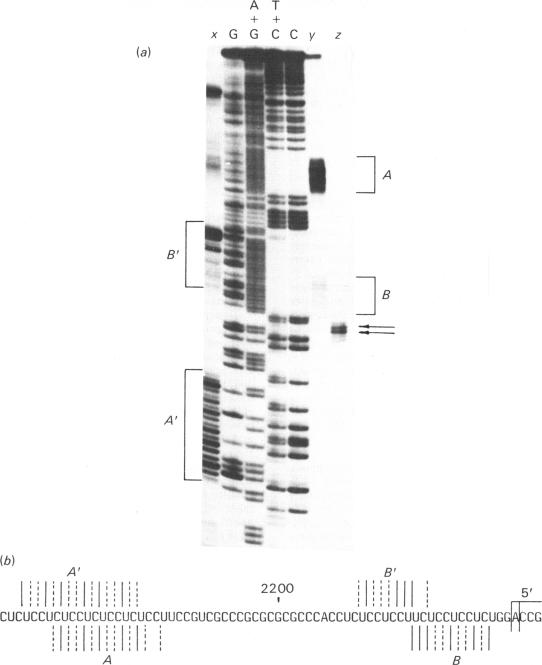
The initial endonuclease cleavage site in 32 S pre-rRNA (precursor to rRNA) is located within the rate rDNA sequence by S1-nuclease protection mapping of purified nucleolar 28 S rRNA and 12 S pre-rRNA. The heterogeneous 5'- and 3'-termini of these rRNA abut and map within two CTC motifs in tSi2 (internal transcribed spacer 2) located at 50-65 and 4-20 base-pairs upstream from the homogeneous 5'-end of the 28 S rRNA gene. These results show that multiple endonuclease cleavages occur at CUC sites in tSi2 to generate 28 S rRNA and 12 S pre-rRNA with heterogeneous 5'- and 3'-termini, respectively. These molecules have to be processed further to yield mature 28 S and 5.8 S rRNA. Thermal-denaturation studies revealed that the base-pairing association in the 12 S pre-rRNA:28 S rRNA complex is markedly stronger than that in the 5.8 S:28 S rRNA complex. The sequence of about one-quarter (1322 base-pairs) of the 5'-part of the rat 28 S rDNA was determined. A computer search reveals the possibility that the cleavage sites in the CUC motifs are single-stranded, flanked by strongly base-paired GC tracts, involving tSi2 and 28 S rRNA sequences. The subsequent nuclease cleavages, generating the termini of mature rRNA, seem to be directed by secondary-structure interactions between 5.8 S and 28 S rRNA segments in pre-rRNA. An analysis for base-pairing among evolutionarily conserved sequences in 32 S pre-rRNA suggests that the cleavages yielding mature 5.8 S and 28 S rRNA are directed by base-pairing between (i) the 3'-terminus of 5.8 S rRNA and the 5'-terminus of 28 S rRNA and (ii) the 5'-terminus of 5.8 S rRNA and internal sequences in domain I of 28 S rRNA. A general model for primary- and secondary-structure interactions in pre-rRNA processing is proposed, and its implications for ribosome biogenesis in eukaryotes are briefly discussed.
通过对纯化的核仁28 S rRNA和12 S前体rRNA进行S1核酸酶保护图谱分析,发现32 S前体rRNA(rRNA的前体)中的初始核酸内切酶切割位点位于速率rDNA序列内。这些rRNA的异质5′和3′末端邻接并定位在位于28 S rRNA基因均匀5′末端上游50 - 65和4 - 20碱基对处的tSi2(内部转录间隔区2)中的两个CTC基序内。这些结果表明,在tSi2的CUC位点发生多次核酸内切酶切割,分别产生具有异质5′和3′末端的28 S rRNA和12 S前体rRNA。这些分子必须进一步加工才能产生成熟的28 S和5.8 S rRNA。热变性研究表明,12 S前体rRNA:28 S rRNA复合物中的碱基配对结合明显强于5.8 S:28 S rRNA复合物中的碱基配对结合。测定了大鼠28 S rDNA 5′部分约四分之一(1322碱基对)的序列。计算机搜索揭示了CUC基序中的切割位点可能是单链的,两侧是强碱基配对的GC序列,涉及tSi2和28 S rRNA序列。随后产生成熟rRNA末端的核酸酶切割似乎是由前体rRNA中5.8 S和28 S rRNA片段之间的二级结构相互作用指导的。对32 S前体rRNA中进化保守序列之间碱基配对的分析表明,产生成熟5.8 S和28 S rRNA的切割是由以下两者之间的碱基配对指导的:(i)5.8 S rRNA的3′末端和28 S rRNA的5′末端,以及(ii)5.8 S rRNA的5′末端和28 S rRNA结构域I中的内部序列。提出了前体rRNA加工中一级和二级结构相互作用的一般模型,并简要讨论了其对真核生物核糖体生物发生的影响。