Lambert J M, Boileau G, Howe J G, Traut R R
J Bacteriol. 1983 Jun;154(3):1323-8. doi: 10.1128/jb.154.3.1323-1328.1983.
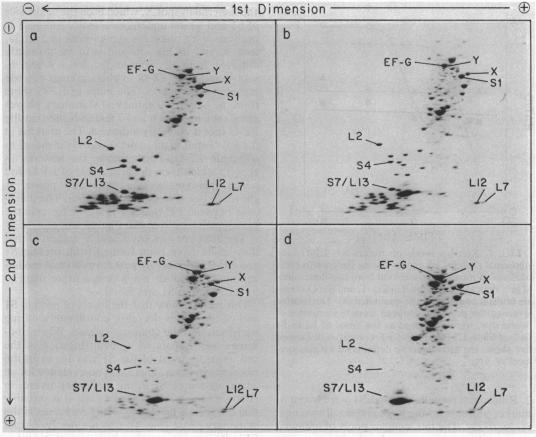
The relative levels of ribosomes, ribosomal protein S1, and elongation factor G in the growth cycle of Escherichia coli were examined with two-dimensional polyacrylamide gel electrophoresis. Nonequilibrium pH gradient polyacrylamide gel electrophoresis was used in the first dimension, and polyacrylamide gradient-sodium dodecyl sulfate gel electrophoresis was used in the second dimension. The identities of protein spots containing S1 and elongation factor G were confirmed by radioiodination of the proteins and peptide mapping of the radiolabeled peptides. The levels of ribosomes and ribosomal protein S1 were coordinately reduced during transition from exponential phase to stationary phase. There was no accumulation of S1 in the stationary phase. In marked contrast, the level of elongation factor G showed no significant change from exponential phase to stationary phase. The relative level of elongation factor G compared with ribosomes or S1 increased by about 2.5-fold during transition from exponential phase to stationary phase. The results show that there are differences between the regulation of the levels of elongation factor G and of ribosomal proteins, including S1, apparent during the transition from exponential to stationary phase.
利用二维聚丙烯酰胺凝胶电泳检测了大肠杆菌生长周期中核糖体、核糖体蛋白S1和延伸因子G的相对水平。第一维采用非平衡pH梯度聚丙烯酰胺凝胶电泳,第二维采用聚丙烯酰胺梯度 - 十二烷基硫酸钠凝胶电泳。通过蛋白质的放射性碘化和放射性标记肽段的肽图谱分析,确认了含有S1和延伸因子G的蛋白质斑点的身份。在从指数生长期向稳定期转变过程中,核糖体和核糖体蛋白S1的水平协同降低。在稳定期没有S1的积累。与之形成显著对比的是,延伸因子G的水平从指数生长期到稳定期没有显著变化。在从指数生长期向稳定期转变过程中,延伸因子G与核糖体或S1相比的相对水平增加了约2.5倍。结果表明,在从指数生长期到稳定期的转变过程中,延伸因子G和包括S1在内的核糖体蛋白水平的调节存在差异。