Wilson B S, Lloyd R V
Am J Pathol. 1984 Jun;115(3):458-68.
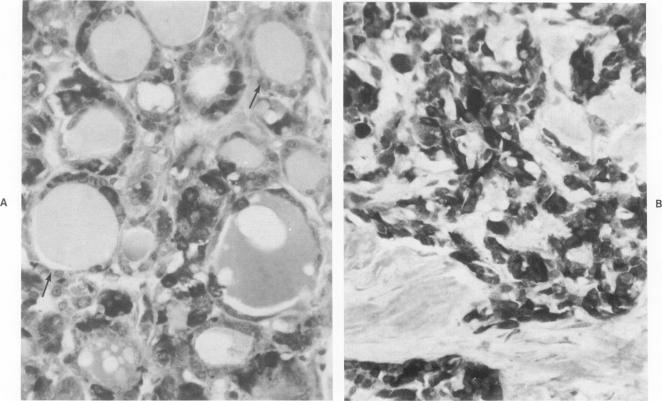
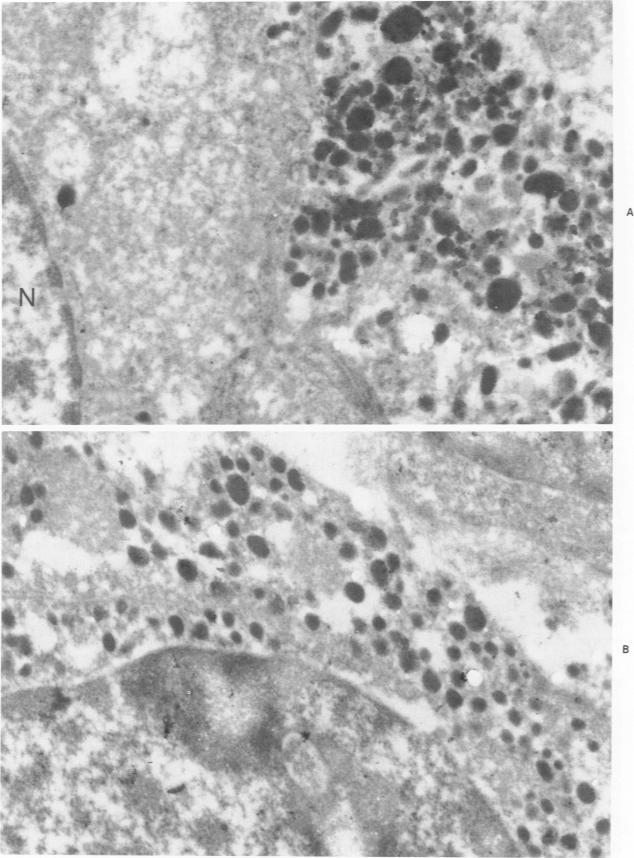
A monoclonal antibody ( LK2H10 ) produced against a human pheochromocytoma reacted immunohistochemically with 126 normal and neoplastic endocrine tissues with secretory granules which were formalin-fixed and paraffin-embedded. Antibody LK2H10 did not react with 46 other endocrine tissues or tumors without secretory granules nor with 113 normal and neoplastic nonendocrine cells and tumors. Tumors with abundant secretory granules showed intense and diffuse staining, and tumors with few granules, such as Merkel cell carcinomas, neuroblastomas, and small cell carcinomas of lung, showed focal staining. Antibody LK2H10 did not react with melanomas, nevi, posterior pituitary, peripheral nerve tissues, or neurons. The target structure of LK2H10 was identified as human chromogranin, of which the major fraction was chromogranin A (mol wt 68,000 daltons). Preabsorption with purified chromogranin A blocked immunoperoxidase staining by LK2H10 in normal adrenal medulla, in the anterior pituitary, and in a pheochromocytoma. Ultrastructural immunohistochemistry with LK2H10 showed that chromogranin was present in cytoplasmic secretory granules. These results indicate that chromogranin is widely distributed in the secretory granules of most polypeptide-producing endocrine tissues, and it is readily detected with the use of monoclonal antibody LK2H10 . The detection of this marker can be very helpful as a diagnostic aid for neuroendocrine cells and tumors.
一种针对人嗜铬细胞瘤产生的单克隆抗体(LK2H10),通过免疫组织化学方法与126个经福尔马林固定和石蜡包埋的、含有分泌颗粒的正常和肿瘤性内分泌组织发生反应。抗体LK2H10与46个其他不含分泌颗粒的内分泌组织或肿瘤以及113个正常和肿瘤性非内分泌细胞及肿瘤均无反应。含有丰富分泌颗粒的肿瘤呈现强烈而弥漫的染色,而颗粒较少的肿瘤,如默克尔细胞癌、神经母细胞瘤和肺小细胞癌,则呈现局灶性染色。抗体LK2H10与黑色素瘤、痣、垂体后叶、周围神经组织或神经元均无反应。LK2H10的靶结构被鉴定为人嗜铬粒蛋白,其中主要成分是嗜铬粒蛋白A(分子量68,000道尔顿)。用纯化的嗜铬粒蛋白A进行预吸收可阻断LK2H10在正常肾上腺髓质、垂体前叶和嗜铬细胞瘤中的免疫过氧化物酶染色。用LK2H10进行超微结构免疫组织化学显示,嗜铬粒蛋白存在于细胞质分泌颗粒中。这些结果表明,嗜铬粒蛋白广泛分布于大多数产生多肽的内分泌组织的分泌颗粒中,并且使用单克隆抗体LK2H10很容易检测到它。该标志物的检测作为神经内分泌细胞和肿瘤的诊断辅助手段可能非常有帮助。