Willick G E, Morosoli R, Seligy V L, Yaguchi M, Desrochers M
J Bacteriol. 1984 Jul;159(1):294-9. doi: 10.1128/jb.159.1.294-299.1984.
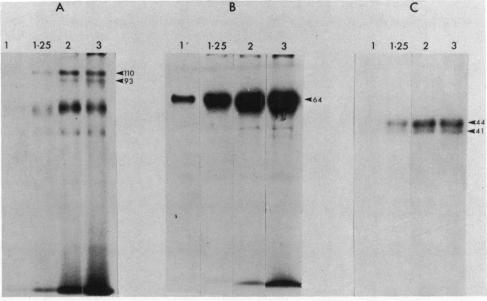
The secretion of 1,4-beta-D-glucanases by the basidiomycete Schizophyllum commune in response to cellulose or cellobiose has been studied. The proteins were labeled with 35S, and the secretion of enzymes was measured by beta-glucosidase and carboxymethyl cellulase activities and by immunoprecipitation with specific antibodies. The antigen proteins used were a beta-glucosidase (Mr, 93,000), an avicelase (avicelase II; Mr, 64,000), and a carboxymethyl cellulose (carboxymethyl cellulase I; Mr 41,000). The beta-glucosidase was initially secreted as an Mr 110,000 form, which was followed later by lower-molecular-weight (88,000 to 93,000) forms. The avicelase II, which accounted for about 50% of the secreted labeled protein, had an Mr of 64,000. Secretion of the related avicelase I (Mr 61,000) followed later. The carboxymethyl cellulose I was secreted in two molecular weight forms, Mr 44,000 and 41,000. The evidence is consistent with the idea that three genes account for the secreted glucanase activities. Other species result from different glycosylation or proteolytic cleavage processing, which may occur during or after secretion. The beta-glucosidase secretion appears to be regulated differently than that of avicelase II or carboxymethyl cellulase I; the latter two were regulated coordinately under the conditions used in this work. No common immune determinants between the three antigens were observed.
已对担子菌裂褶菌在响应纤维素或纤维二糖时分泌1,4-β-D-葡聚糖酶的情况进行了研究。蛋白质用35S标记,通过β-葡萄糖苷酶和羧甲基纤维素酶活性以及用特异性抗体进行免疫沉淀来测定酶的分泌。所使用的抗原蛋白有β-葡萄糖苷酶(分子量93,000)、微晶纤维素酶(微晶纤维素酶II;分子量64,000)和羧甲基纤维素酶(羧甲基纤维素酶I;分子量41,000)。β-葡萄糖苷酶最初以分子量110,000的形式分泌,随后是较低分子量(88,000至93,000)的形式。占分泌的标记蛋白约50%的微晶纤维素酶II,其分子量为64,000。相关的微晶纤维素酶I(分子量61,000)随后分泌。羧甲基纤维素酶I以两种分子量形式分泌,分子量分别为44,000和41,000。证据与三个基因负责分泌的葡聚糖酶活性这一观点一致。其他种类是由不同的糖基化或蛋白水解切割加工产生的,这些加工可能在分泌期间或之后发生。β-葡萄糖苷酶的分泌似乎与微晶纤维素酶II或羧甲基纤维素酶I的分泌受不同调节;后两者在本研究使用的条件下是协同调节的。在这三种抗原之间未观察到共同的免疫决定簇。