Nielsen O F, Carin M, Westergaard O
Nucleic Acids Res. 1984 Jan 25;12(2):873-86. doi: 10.1093/nar/12.2.873.
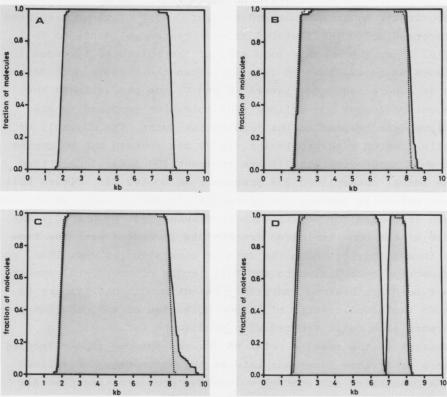
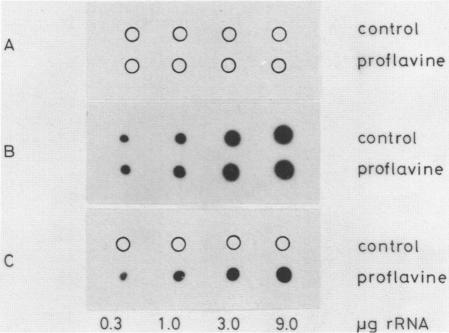
In isolated nucleoli from Tetrahymena thermophila, low concentrations of the intercalating agent proflavine inhibit both transcription termination and splicing of the rRNA precursor. Proflavine also exerts an in vivo effect on the process of transcription termination under conditions, where the growth rate is only slightly reduced. Thus, approximately 40% of the rRNA precursor molecules, accumulated in nucleoli during 60 min of treatment with the drug, are longer than the normal 35S rRNA precursor. R-Loop mapping of these longer precursor molecules isolated after 30 and 60 min of incubation demonstrates that the RNA polymerases have a 50 fold lower elongation rate in the spacer region than in the coding region. Proflavine in the given concentration is found to have no significant effect on the splicing of properly terminated precursor molecules. In contrast, none of the longer non-terminated molecules are found to be spliced. These results indicate that proflavine primarily affects the process of transcription termination and that the splicing event is inhibited due to the improper termination of the precursor molecule.
在嗜热四膜虫的分离核仁中,低浓度的嵌入剂原黄素可抑制rRNA前体的转录终止和剪接。在生长速率仅略有降低的条件下,原黄素对转录终止过程也有体内效应。因此,在用该药物处理60分钟期间,在核仁中积累的约40%的rRNA前体分子比正常的35S rRNA前体更长。对孵育30分钟和60分钟后分离出的这些较长前体分子进行R环作图表明,RNA聚合酶在间隔区的延伸速率比在编码区低50倍。发现给定浓度的原黄素对正确终止的前体分子的剪接没有显著影响。相反,未发现任何较长的未终止分子被剪接。这些结果表明,原黄素主要影响转录终止过程,并且由于前体分子的终止不当,剪接事件受到抑制。