O'Connor B L
J Anat. 1984 Jan;138 ( Pt 1)(Pt 1):15-26.
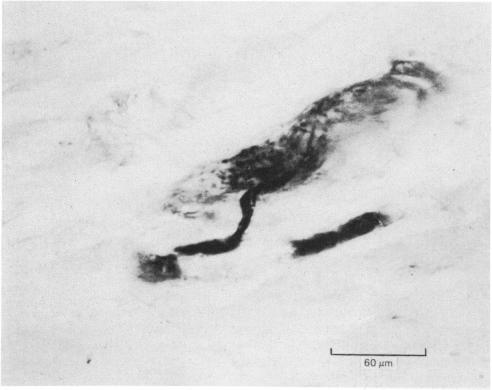
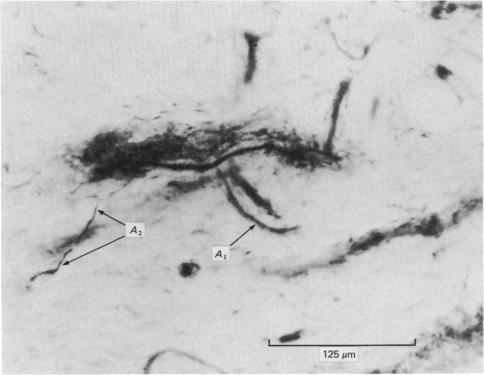
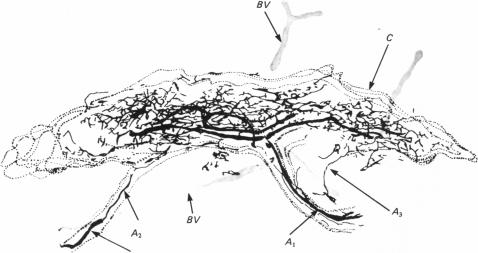
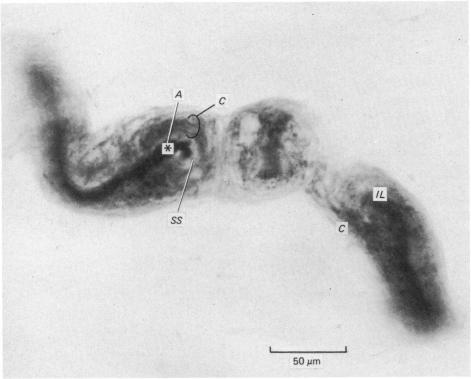
The posterior attachments of the dog knee joint lateral menisci have been studied to identify and characterize their mechanoreceptor innervation. Two basic types of mechanoreceptor were identified that appeared to be similar to the Type III and Type II endings described by Freeman & Wyke (1967) in cat knee periarticular tissues. Significantly, two distinct forms of Type II corpuscles were identified in this study, referred to as Types IIa and IIb, respectively. Endings were usually identified either at the point where the posterior meniscotibial ligament merged with the main body of the meniscus and the meniscofemoral ligament, or within the inner aspect of the meniscofemoral ligament where it joined the meniscal 'body'. The presence of encapsulated mechanoreceptors within the attachments of dog knee lateral menisci means that the central nervous system is being appraised of the mechanical state of these structures. A mechanism is suggested by which the tension of meniscal attachments could be varied according to knee joint position. A possible relationship between the morphology of the receptors identified in this study and the physiological responses of similar cat knee joint receptors is discussed.
对犬膝关节外侧半月板的后部附着结构进行了研究,以识别和描述其机械感受器的神经支配。研究发现了两种基本类型的机械感受器,它们似乎类似于Freeman和Wyke(1967年)在猫膝关节周围组织中描述的III型和II型末梢。值得注意的是,本研究中识别出了两种不同形式的II型小体,分别称为IIa型和IIb型。末梢通常在半月板胫骨后韧带与半月板主体和半月板股骨韧带融合处,或在半月板股骨韧带与半月板“本体”相连的内侧部分被识别。犬膝关节外侧半月板附着结构中存在被囊化的机械感受器,这意味着中枢神经系统在评估这些结构的机械状态。本文提出了一种机制,通过该机制,半月板附着结构的张力可根据膝关节位置而变化。本文还讨论了本研究中识别出的感受器形态与类似猫膝关节感受器生理反应之间的可能关系。