Monroe S S, Ou J H, Rice C M, Schlesinger S, Strauss E G, Strauss J H
J Virol. 1982 Jan;41(1):153-62. doi: 10.1128/JVI.41.1.153-162.1982.
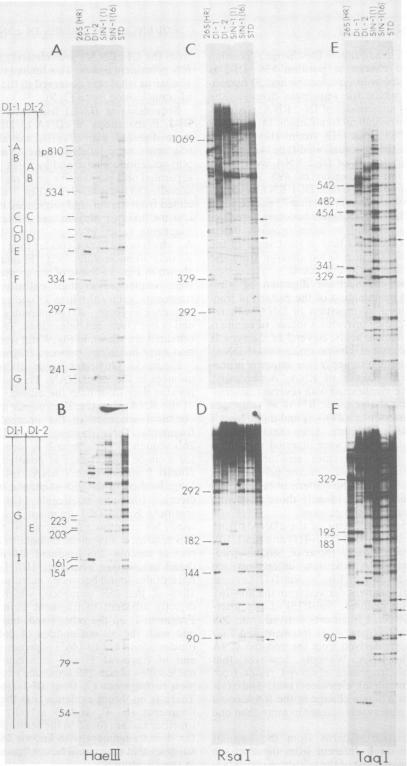
Sindbis virus generates defective interfering (DI) particles during serial high-multiplicity passage in cultured cells. These DI particles inhibit the replication of infectious virus and can be an important factor in the establishment and maintenance of persistent infection in BHK cells. In an effort to understand how these DI particles are generated and how they interfere with the replication of standard virus, we performed a partial sequence analysis of the RNA obtained from two independently isolated populations of DI particles and from two Sindbis virus variants and compared these with the RNA of the parental wild-type virus. The 3'-terminal regions of the RNAs were sequenced by the dideoxy chain terminating method. Internal regions of the RNA were examined by restriction endonuclease digestion of cDNA's made to the various RNAs and by direct chemical sequencing of 5' end-labeled restriction fragments from cDNA made to the DI RNAs. One of the variant viruses examined was originally derived from cells persistently infected with Sindbis virus for 16 months and is resistant to interference by the DI strains used. In the 3'-terminal region of the RNA from this variant, only two base changes were found; one of these occurs in the 20-nucleotide 3'-terminal sequence which is highly conserved among alphaviruses. The DI RNA sequences were found to have been produced not by a single deletional event, but by multiple deletion steps combined with sequence rearrangements; all sequences examined are derived from the plus strand of Sindbis virion RNA. Both DI RNAs had at least 50 nucleotides of wild-type sequence conserved at the 3' terminus; in addition, they both contained conserved and perhaps amplified sequences derived from the non-26S region of the genome which may be of importance in their replication and interference ability.
辛德毕斯病毒在培养细胞中连续高倍传代时会产生缺陷干扰(DI)颗粒。这些DI颗粒抑制感染性病毒的复制,并且可能是在BHK细胞中建立和维持持续性感染的一个重要因素。为了了解这些DI颗粒是如何产生的以及它们如何干扰标准病毒的复制,我们对从两个独立分离的DI颗粒群体以及两个辛德毕斯病毒变体中获得的RNA进行了部分序列分析,并将这些与亲本野生型病毒的RNA进行了比较。通过双脱氧链终止法对RNA的3'-末端区域进行测序。通过对各种RNA制备的cDNA进行限制性内切酶消化以及对DI RNA制备的cDNA的5'末端标记的限制性片段进行直接化学测序来检查RNA的内部区域。所检测的变体病毒之一最初来自持续感染辛德毕斯病毒16个月的细胞,并且对所用的DI毒株的干扰具有抗性。在该变体的RNA的3'-末端区域,仅发现了两个碱基变化;其中一个发生在20个核苷酸的3'-末端序列中,该序列在甲病毒中高度保守。发现DI RNA序列不是由单个缺失事件产生的,而是由多个缺失步骤与序列重排相结合产生的;所有检测的序列均源自辛德毕斯病毒粒子RNA的正链。两种DI RNA在3'末端都至少有50个核苷酸的野生型序列保守;此外,它们都包含源自基因组非26S区域的保守且可能扩增的序列,这些序列可能对它们的复制和干扰能力很重要。