Olexa S A, Budzynski A Z
Proc Natl Acad Sci U S A. 1980 Mar;77(3):1374-8. doi: 10.1073/pnas.77.3.1374.
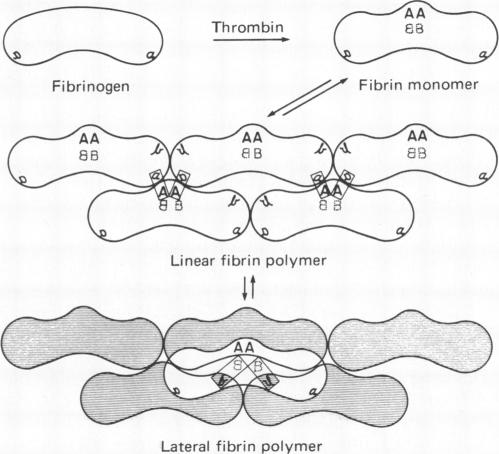
The mechanism of association and the organization of human fibrin were studied by using affinity chromatography. Insolubilized fibrinogen, fibrin monomer, and crosslinked fibrin were used to localize the binding sites on fibrinogen and fibrin derivatives. Four different polymerization sites have been distinguished. A binding site ("a"), available without thrombin action, is present on the fibrinogen fragment D domain. The complementary ("A") is inoperative in fibrinogen and requires thrombin for activation; it is located on the fibrinogen NH2-terminal domain. A third polymerization site ("b") appears to be formed by the alignment of the fragment D domains on two fibrin monomer molecules upon polymerization; this site functions without thrombin mediation and the alignment is stabilized by the Factor XIIIa-catalyzed crosslink bonds. The "b" site is complementary to another thrombin-activated site ("B") on the fibrinogen NH2-terminal domain. The two thrombin activable sites, "A" and "B", are distinguishable, although they are located in the same fibrinogen domain.
利用亲和色谱法研究了人纤维蛋白的缔合机制和组织结构。使用不溶性纤维蛋白原、纤维蛋白单体和交联纤维蛋白来定位纤维蛋白原和纤维蛋白衍生物上的结合位点。已区分出四个不同的聚合位点。一个无需凝血酶作用即可利用的结合位点(“a”)存在于纤维蛋白原D片段结构域上。互补位点(“A”)在纤维蛋白原中不起作用,需要凝血酶激活;它位于纤维蛋白原的NH2末端结构域。第三个聚合位点(“b”)似乎是在聚合时由两个纤维蛋白单体分子上的D片段结构域排列形成的;该位点在无凝血酶介导的情况下起作用,并且这种排列通过因子XIIIa催化的交联键得以稳定。“b”位点与纤维蛋白原NH2末端结构域上的另一个凝血酶激活位点(“B”)互补。两个可被凝血酶激活的位点,“A”和“B”,尽管位于同一纤维蛋白原结构域中,但却是可区分的。