van Steeg H, Thomas A, Verbeek S, Kasperaitis M, Voorma H O, Benne R
J Virol. 1981 May;38(2):728-36. doi: 10.1128/JVI.38.2.728-736.1981.
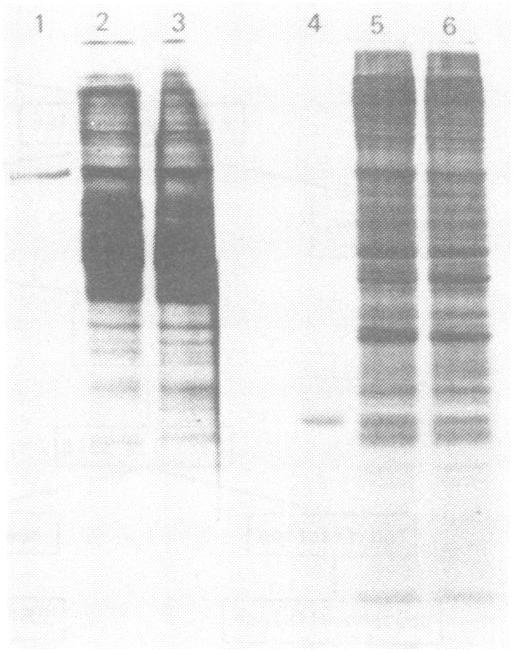
A crude ribosomal wash containing the initiation factors of protein synthesis was isolated from mouse neuroblastoma cells 8 h after infection with Semliki Forest virus (SFV). The activity of this wash was compared with that of a wash from control cells in a cell-free protein-synthesizing "pH5" system, with early SFV mRNA (42S), late SFV mRNA (26S), encephalomyocarditis virus (EMC) mRNA, or neuroblastoma polyadenylated mRNA templates. A pronounced loss of activity (+/-80%) of the crude ribosomal wash from infected cells was observed with host mRNA (neuroblastoma polyadenylated mRNA) and early SFV mRNA, messengers which contain a cap structure at the 5' terminus. However, these washes were only slightly less active in systems programmed with (noncapped) EMC mRNA and late SFV mRNA. Although late SFV mRNA (26S) is capped, the synthesis of late (= structural) proteins in infected lysates was insensitive to inhibition by cap analogs. Purified initiation factors eIF-4B (M(r), 80,000) and cap-binding protein (M(r), 24,000) from reticulocytes (but none of the others) were able to restore the activity of infected factors to about 90% of control levels in systems programmed with early SFV mRNA and host mRNA. These observations indicate that infection-exposed crude initiation factors have a decreased level of eIF-4B and cap-binding protein activity. However, after partial purification of these and other initiation factors from infected and control cells, we found no significant difference in activity when model assay systems were used. Furthermore, both eIF-4B and cap-binding protein from infected cells were able to restore the activity of these infection-exposed factors to the same level obtained when these factors isolated from control cells or reticulocytes were added. A possible mechanism for the shutoff of host cell protein synthesis is discussed.
在感染辛德毕斯病毒(SFV)8小时后,从小鼠神经母细胞瘤细胞中分离出一种含有蛋白质合成起始因子的粗核糖体洗涤液。在无细胞蛋白质合成的“pH5”系统中,将这种洗涤液的活性与对照细胞洗涤液的活性进行比较,使用早期SFV mRNA(42S)、晚期SFV mRNA(26S)、脑心肌炎病毒(EMC)mRNA或神经母细胞瘤多聚腺苷酸化mRNA模板。观察到,对于宿主mRNA(神经母细胞瘤多聚腺苷酸化mRNA)和早期SFV mRNA(这两种信使RNA在5'末端含有帽结构),感染细胞的粗核糖体洗涤液活性明显丧失(±80%)。然而,在用(无帽)EMC mRNA和晚期SFV mRNA编程的系统中,这些洗涤液的活性仅略有降低。尽管晚期SFV mRNA(26S)有帽结构,但感染裂解物中晚期(即结构)蛋白的合成对帽类似物的抑制不敏感。来自网织红细胞的纯化起始因子eIF-4B(分子量80,000)和帽结合蛋白(分子量24,000)(但不是其他因子)能够在使用早期SFV mRNA和宿主mRNA编程的系统中,将感染因子的活性恢复到对照水平的约90%。这些观察结果表明,受感染暴露的粗起始因子中eIF-4B和帽结合蛋白的活性水平降低。然而,在从感染细胞和对照细胞中对这些及其他起始因子进行部分纯化后,当使用模型检测系统时,我们发现它们的活性没有显著差异。此外,感染细胞中的eIF-4B和帽结合蛋白都能够将这些受感染暴露因子的活性恢复到添加从对照细胞或网织红细胞中分离出的这些因子时所获得的相同水平。本文讨论了宿主细胞蛋白质合成关闭的一种可能机制。