Haworth S G, Rees P G, Taylor J F, Macartney F J, de Leval M, Stark J
Br Heart J. 1981 Feb;45(2):133-41. doi: 10.1136/hrt.45.2.133.
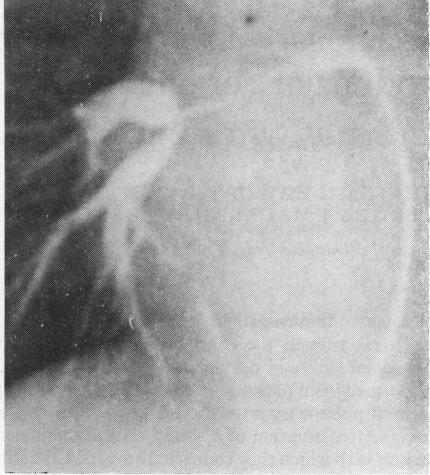
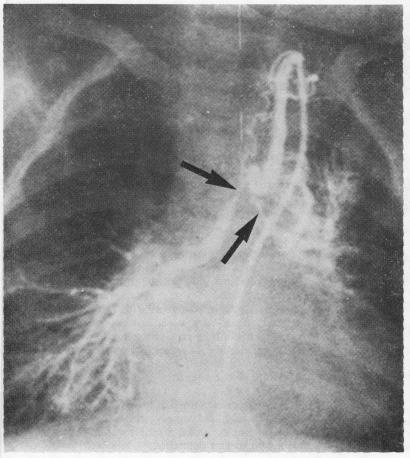
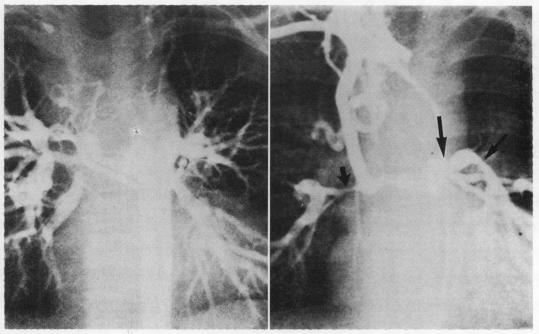
In nine patients with pulmonary atresia, ventricular septal defect, and major aortopulmonary collateral arteries, the effect of a systemic-pulmonary anastomosis on the lung was studied by comparison of pre- and postoperative cine angiograms. Selective injections into the collateral arteries were performed in all patients and the source of blood supply to each bronchopulmonary segment was sought. Central pulmonary arteries were present in six children and absent in three, as confirmed at thoracotomy. After insertion of a shunt, central pulmonary arteries increased in size, but the intrapulmonary vessels with which they connected remained abnormally small and were frequently stenosed. In addition, in each case the central pulmonary arteries increased flow to only five to 11 segments of lung. In the absence of central pulmonary arteries, shunting to a hilar or a lobar pulmonary artery increased perfusion to five to nine segments of lung per case. In all these three cases the pulmonary arteries at lobar level showed aneurysmal dilatation proximal to a severe stenosis. Sixty-eight per cent of collateral arteries were stenosed. The findings suggest that in this anomaly, when the central pulmonary arteries are hypoplastic, the intrapulmonary branches are also hypoplastic, emphasising the need for early surgical intervention to increase blood flow while the lung still has growth potential. Further, one collateral artery may connect with at least as many bronchopulmonary segments as does a central pulmonary artery, and the peripheral intrapulmonary arteries with which it connects may appear at least as normal angiographically as do vessels connected to central pulmonary arteries. These observations suggest that segments of lung connected to collaterals alone should, and sometimes can, be connected to central pulmonary arteries, the aim being to produce a unifocal blood supply as a prelude to total correction.
在9例患有肺动脉闭锁、室间隔缺损和主要体肺侧支动脉的患者中,通过比较术前和术后的电影血管造影来研究体肺分流术对肺的影响。对所有患者的侧支动脉进行了选择性注射,并寻找每个支气管肺段的血供来源。开胸手术证实,6名儿童存在中央肺动脉,3名儿童不存在中央肺动脉。插入分流管后,中央肺动脉尺寸增大,但其相连的肺内血管仍异常细小且常出现狭窄。此外,在每种情况下,中央肺动脉仅使5至11个肺段的血流增加。在没有中央肺动脉的情况下,向肺门或叶肺动脉分流使每例患者5至9个肺段的灌注增加。在所有这3例病例中,叶水平的肺动脉在严重狭窄近端呈瘤样扩张。68%的侧支动脉存在狭窄。这些发现表明,在这种畸形中,当中央肺动脉发育不全时,肺内分支也发育不全,这强调了在肺仍有生长潜力时尽早进行手术干预以增加血流量的必要性。此外,一条侧支动脉可能与至少和中央肺动脉一样多的支气管肺段相连,并且其相连的外周肺内动脉在血管造影上可能至少和与中央肺动脉相连的血管一样正常。这些观察结果表明,仅与侧支相连的肺段应该并且有时能够与中央肺动脉相连,目的是形成单一血供作为完全矫正的前奏。