DiCroce P A, Krontiris T G
Department of Medicine (Hematology/Oncology), Tufts University School of Medicine, Boston, MA, USA.
Proc Natl Acad Sci U S A. 1995 Oct 24;92(22):10137-41. doi: 10.1073/pnas.92.22.10137.
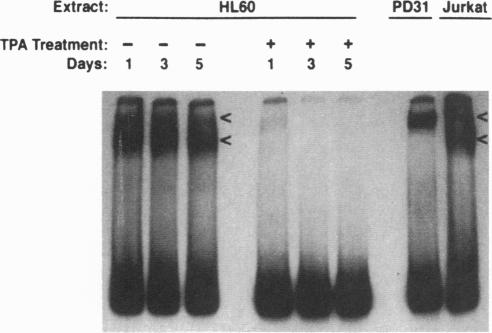
The majority of translocations involving BCL2 are very narrowly targeted to three breakpoint clusters evenly spaced over a 100-bp region of the gene's terminal exon. We have recently shown that the immediate upstream boundary of this major breakpoint region (mbr) is a specific recognition site for single-strand DNA (ssDNA) binding proteins on the sense and antisense strands. The downstream flank of the mbr is a helicase binding site. In this report we demonstrate that the helicase and ssDNA binding proteins show reciprocal changes in binding activity over the cell cycle. The helicase is maximally active in G1 and early S phases; the ssDNA binding proteins are maximally active in late S and G2/M phases. An inhibitor of helicase binding appears in late S and G2/M. Finally, at least one component of the helicase binding complex is the Ku antigen. Thus, a protein with helicase activity implicated in repair of double-strand breaks, variable (diversity) joining recombination, and, potentially, cell-cycle regulation is targeted to the BCL2 mbr.
大多数涉及BCL2的易位非常狭窄地靶向于该基因末端外显子100个碱基对区域内均匀分布的三个断点簇。我们最近发现,这个主要断点区域(mbr)的紧邻上游边界是单链DNA(ssDNA)结合蛋白在正义链和反义链上的特异性识别位点。mbr的下游侧翼是解旋酶结合位点。在本报告中,我们证明解旋酶和ssDNA结合蛋白在细胞周期中的结合活性呈现相互变化。解旋酶在G1期和S期早期活性最高;ssDNA结合蛋白在S期后期和G2/M期活性最高。一种解旋酶结合抑制剂出现在S期后期和G2/M期。最后,解旋酶结合复合物的至少一个组分是Ku抗原。因此,一种具有解旋酶活性的蛋白质,参与双链断裂修复、可变(多样性)连接重组以及潜在的细胞周期调控,被靶向至BCL2 mbr。