Bonnefoy-Bérard N, Liu Y C, von Willebrand M, Sung A, Elly C, Mustelin T, Yoshida H, Ishizaka K, Altman A
Division of Cell Biology, La Jolla Institute for Allergy and Immunology, CA 92037, USA.
Proc Natl Acad Sci U S A. 1995 Oct 24;92(22):10142-6. doi: 10.1073/pnas.92.22.10142.
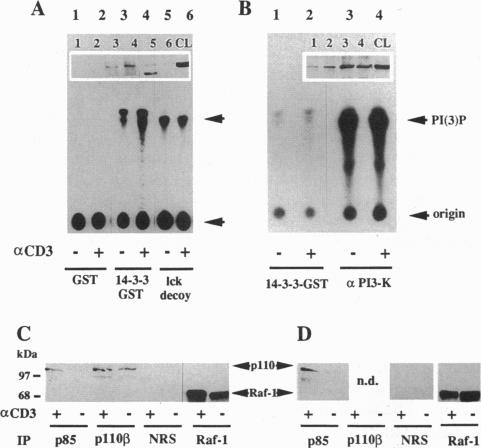
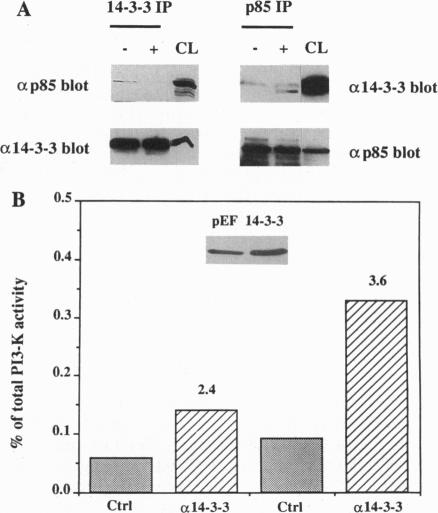
Proteins of the 14-3-3 family can associate with, and/or modulate the activity of, several protooncogene and oncogene products and, thus, are implicated in regulation of signaling pathways. We report that 14-3-3 is associated with another important transducing enzyme, phosphatidylinositol 3-kinase (PI3-K). A recombinant 14-3-3 fusion protein bound several tyrosine-phosphorylated proteins from antigen receptor-stimulated T lymphocytes. PI3-K was identified by immunoblotting and enzymatic assays as one of the 14-3-3-binding proteins in resting or activated cells. Moreover, endogenous 14-3-3 and PI3-K were coimmunoprecipitated from intact T cells. Far-Western blots of gel-purified, immunoprecipitated PI3-K with a recombinant 14-3-3 fusion protein revealed direct binding of 14-3-3 to the catalytic subunit (p110) of PI3-K. Finally, anti-phosphotyrosine immunoprecipitates from activated, 14-3-3-overexpressing cells contained lower PI3-K enzymatic activity than similar immunoprecipitates from control cells. These findings suggest that association of 14-3-3 with PI3-K in hematopoietic (and possibly other) cells regulates the enzymatic activity of PI3-K during receptor-initiated signal transduction.
14-3-3家族蛋白可与多种原癌基因和癌基因产物结合及(或)调节其活性,因此参与信号通路的调控。我们报道14-3-3与另一种重要的转导酶磷脂酰肌醇3激酶(PI3-K)相关。一种重组14-3-3融合蛋白能结合来自抗原受体刺激的T淋巴细胞的几种酪氨酸磷酸化蛋白。通过免疫印迹和酶活性测定确定PI3-K是静息或活化细胞中14-3-3结合蛋白之一。此外,内源性14-3-3和PI3-K可从完整的T细胞中共免疫沉淀。用重组14-3-3融合蛋白对凝胶纯化的免疫沉淀PI3-K进行Far-Western印迹分析,结果显示14-3-3可直接与PI3-K的催化亚基(p110)结合。最后,来自活化的、过表达14-3-3的细胞的抗磷酸酪氨酸免疫沉淀产物中的PI3-K酶活性低于来自对照细胞的类似免疫沉淀产物。这些发现表明,在造血(可能还有其他)细胞中14-3-3与PI3-K的结合在受体启动的信号转导过程中调节PI3-K的酶活性。