Vinores S A, Küchle M, Mahlow J, Chiu C, Green W R, Campochiaro P A
Wilmer Ophthalmologic Institute, Johns Hopkins University School of Medicine, Baltimore, Maryland 21287-9289, USA.
Am J Pathol. 1995 Nov;147(5):1289-97.
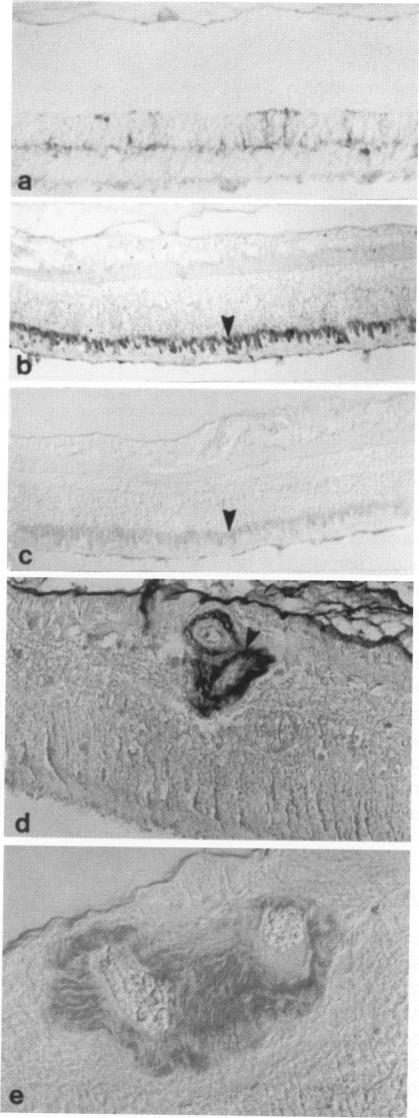
A series of 130 eyes with ocular melanomas, 19 normal eyes, and 18 eyes affected with other disorders leading to blood-ocular barrier (BOB) breakdown were immunohistochemically stained for albumin to localize sites of BOB failure within the retina, ciliary body, and iris. Thirty-nine of the eyes containing melanomas and all of the other eyes were also immunohistochemically stained for vascular endothelial growth factor (VEGF), to investigate its potential role as a mediator for BOB failure. Eyes with melanomas showed widespread leakage through the retinal pigment epithelium, and 58% demonstrated leakage from retinal vessels in the proximity of the tumor. BOB failure remote from the tumor also occurred in retina (50%), optic nerve head (77%), ciliary body (51%), and iris (51%), suggesting that a soluble mediator may be involved. VEGF was demonstrated intraretinally in the proximity of (46%) and remote from (24%) melanomas and in eyes affected by other disease processes, particularly those involving neoplasia or retinal detachments, usually within particular cell populations (ie, retinal vessel walls, ganglion cells, inner or outer nuclear layers, retinal pigment epithelium). VEGF localization in retina, ciliary body, and iris often coincided with sites of extravasated albumin. Preincubation of albumin or VEGF antibodies with normal serum or VEGF peptide, respectively, eliminated or markedly reduced all immunoreactivity. Only 1 of 14 normal postmortem eyes and 0 of 5 normal surgically removed eyes showed VEGF positivity in the retina, 5 of 19 normal eyes had weak positivity in the ciliary body, and VEGF was not demonstrated in the iris of normal eyes. VEGF cannot account for all of the BOB failure associated with ocular melanomas, but appears likely to play a contributing role in many cases.
对130只患有眼黑色素瘤的眼睛、19只正常眼睛以及18只因其他导致血-眼屏障(BOB)破坏的疾病而受累的眼睛进行免疫组织化学染色,以检测白蛋白,从而确定视网膜、睫状体和虹膜内BOB破坏的部位。对39只患有黑色素瘤的眼睛以及所有其他眼睛也进行了血管内皮生长因子(VEGF)的免疫组织化学染色,以研究其作为BOB破坏介质的潜在作用。患有黑色素瘤的眼睛显示出通过视网膜色素上皮的广泛渗漏,58%的眼睛在肿瘤附近的视网膜血管有渗漏。远离肿瘤的BOB破坏也发生在视网膜(50%)、视神经乳头(77%)、睫状体(51%)和虹膜(51%),这表明可能涉及一种可溶性介质。在黑色素瘤附近(46%)和远离黑色素瘤(24%)的视网膜内以及受其他疾病过程影响的眼睛中,特别是那些涉及肿瘤形成或视网膜脱离的眼睛中,通常在特定细胞群(即视网膜血管壁、神经节细胞、内核层或外核层、视网膜色素上皮)内检测到VEGF。VEGF在视网膜、睫状体和虹膜中的定位通常与白蛋白外渗的部位一致。分别用正常血清或VEGF肽对白蛋白或VEGF抗体进行预孵育,可消除或显著降低所有免疫反应性。14只正常死后眼睛中只有1只、5只正常手术摘除的眼睛中没有1只在视网膜中显示VEGF阳性,19只正常眼睛中有5只在睫状体中有弱阳性,正常眼睛的虹膜中未检测到VEGF。VEGF不能解释与眼黑色素瘤相关的所有BOB破坏,但在许多情况下似乎可能起一定作用。