Schreiber M, Baumann B, Cotten M, Angel P, Wagner E F
Research Institute of Molecular Pathology (IMP), Vienna, Austria.
EMBO J. 1995 Nov 1;14(21):5338-49. doi: 10.1002/j.1460-2075.1995.tb00218.x.
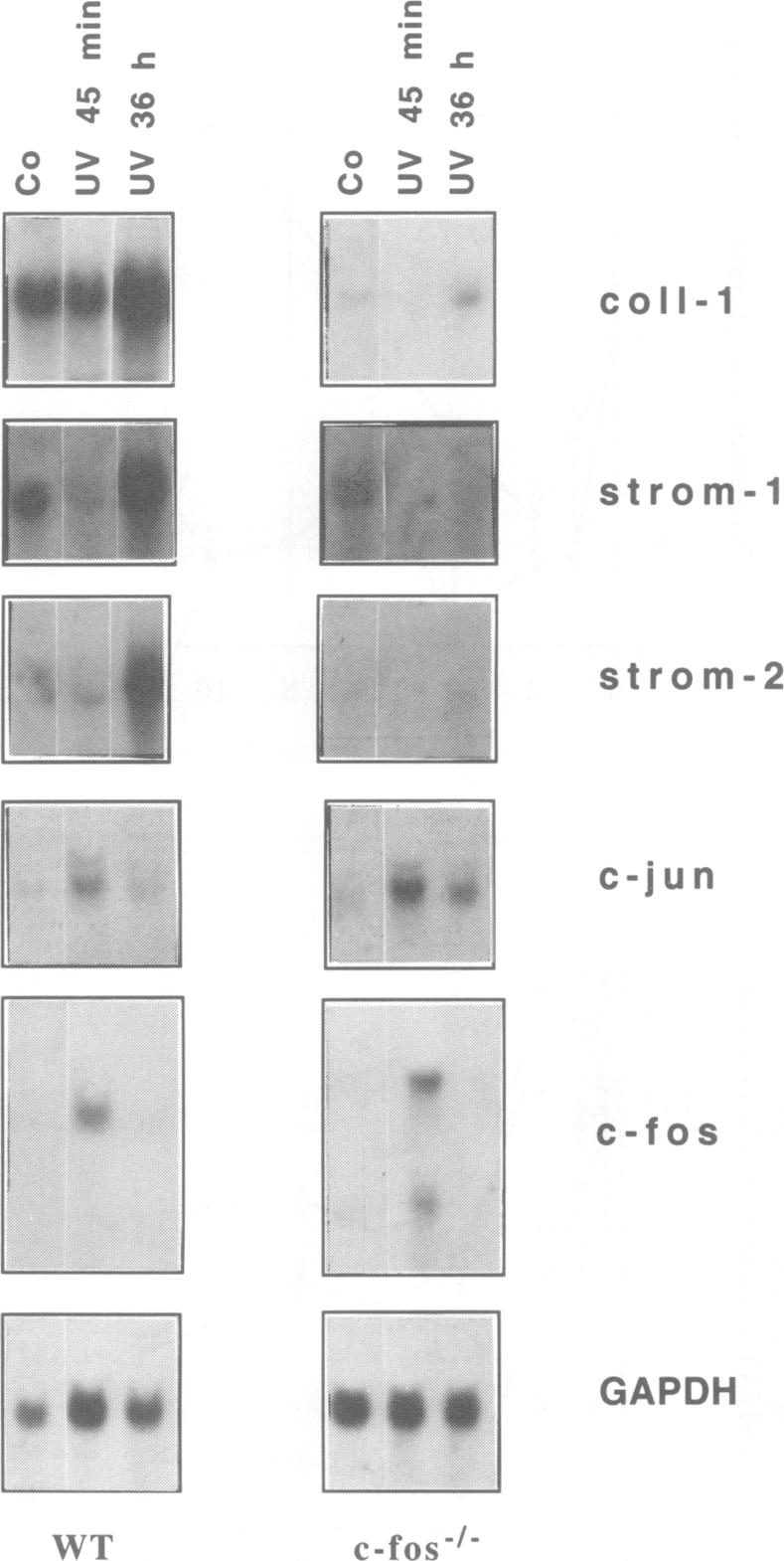
Mouse 3T3 fibroblasts lacking c-fos were employed to demonstrate an essential function of the UV-inducible transcription factor AP-1 (Fos/Jun) in the response to the cytotoxic effects of short-wavelength ultraviolet (UVC) radiation. Clonogenic survival and proliferation of cells lacking c-fos were drastically reduced following UV irradiation. This UV hypersensitivity manifests itself primarily in increased cell death, partly by apoptosis, and prolonged recovery time from UV-induced cell cycle arrest. Co-culture with wild-type cells did not ameliorate the hypersensitivity of mutant cells. Transcriptional induction of the c-Fos target genes collagenase I, stromelysin-1 and stromelysin-2 by UV is almost absent in cells lacking c-fos which correlates with a reduced UV induction of AP-1 DNA-binding and transactivation activity. The repair of UV-induced DNA lesions was not affected, as shown by unscheduled DNA synthesis and host cell reactivation assays. These data demonstrate that c-Fos is involved in a novel protective function other than DNA repair against the harmful consequences of UVC.
缺乏c-fos的小鼠3T3成纤维细胞被用于证明紫外线诱导转录因子AP-1(Fos/Jun)在对短波紫外线(UVC)辐射细胞毒性作用的反应中的重要功能。紫外线照射后,缺乏c-fos的细胞的克隆形成存活率和增殖显著降低。这种紫外线超敏反应主要表现为细胞死亡增加,部分是通过凋亡,以及从紫外线诱导的细胞周期停滞中恢复的时间延长。与野生型细胞共培养并不能改善突变细胞的超敏反应。在缺乏c-fos的细胞中,紫外线对c-Fos靶基因胶原酶I、基质金属蛋白酶-1和基质金属蛋白酶-2的转录诱导几乎不存在,这与AP-1 DNA结合和反式激活活性的紫外线诱导降低相关。如非预定DNA合成和宿主细胞再激活试验所示,紫外线诱导的DNA损伤修复不受影响。这些数据表明,c-Fos除了参与DNA修复外,还参与一种新的保护功能,以对抗UVC的有害后果。