Rink A, Fung K M, Trojanowski J Q, Lee V M, Neugebauer E, McIntosh T K
Department of Neurosurgery, University of Pennsylvania, Philadelphia 19104-6316, USA.
Am J Pathol. 1995 Dec;147(6):1575-83.
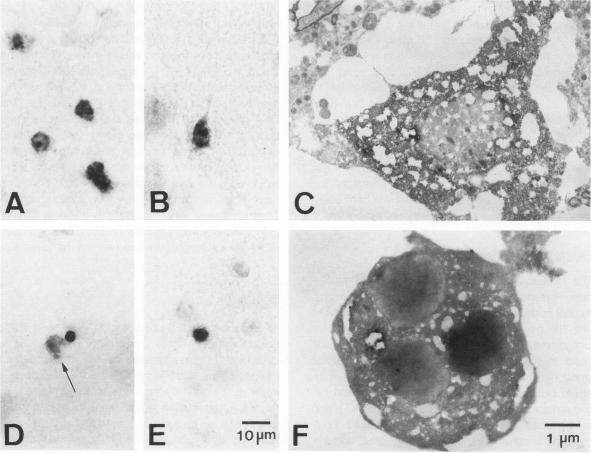
Apoptosis plays an important role in many developmental and pathological processes of the central nervous system. However, the role of apoptosis in traumatic brain injury has not been determined. Using the terminal deoxynucleotidyl transferase-mediated biotinylated deoxyuridine triphosphate nick end labeling (TUNEL) method, we detected many cells with extensive DNA fragmentation in different regions of the brains of rats subjected to experimental traumatic brain injury. Two types of TUNEL-positive cells were demonstrated by light and electron microscopy, including type I cells that displayed morphological features of necrotic cell death and type II cells that displayed morphological features of classic apoptotic cell death. TUNEL-positive cells were detectable for up to 72 hours after the initial injury. Gel electrophoresis of DNA extracted from affected areas of the injured brain containing both type I and II cells revealed only internucleosomal fragmentation at 185-bp intervals, a feature originally described in apoptotic cell death. These data suggest that apoptosis, in addition to necrotic cell death, occurs after traumatic brain injury, and that internucleosomal fragmentation of DNA may be associated with certain types of necrotic cell death.
细胞凋亡在中枢神经系统的许多发育和病理过程中发挥着重要作用。然而,细胞凋亡在创伤性脑损伤中的作用尚未明确。采用末端脱氧核苷酸转移酶介导的生物素化脱氧尿苷三磷酸缺口末端标记法(TUNEL法),我们在实验性创伤性脑损伤大鼠大脑的不同区域检测到许多具有广泛DNA片段化的细胞。通过光学显微镜和电子显微镜证实了两种TUNEL阳性细胞,包括表现出坏死性细胞死亡形态特征的I型细胞和表现出经典凋亡性细胞死亡形态特征的II型细胞。在初次损伤后长达72小时均可检测到TUNEL阳性细胞。从含有I型和II型细胞的损伤大脑受影响区域提取的DNA进行凝胶电泳显示,仅出现间隔为185 bp的核小体间片段化,这是最初在凋亡性细胞死亡中描述的特征。这些数据表明,除坏死性细胞死亡外,创伤性脑损伤后还会发生细胞凋亡,并且DNA的核小体间片段化可能与某些类型的坏死性细胞死亡有关。