Barber G N, Thompson S, Lee T G, Strom T, Jagus R, Darveau A, Katze M G
Department of Microbiology, School of Medicine, University of Washington, Seattle 98195.
Proc Natl Acad Sci U S A. 1994 May 10;91(10):4278-82. doi: 10.1073/pnas.91.10.4278.
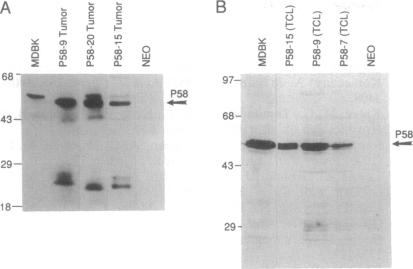
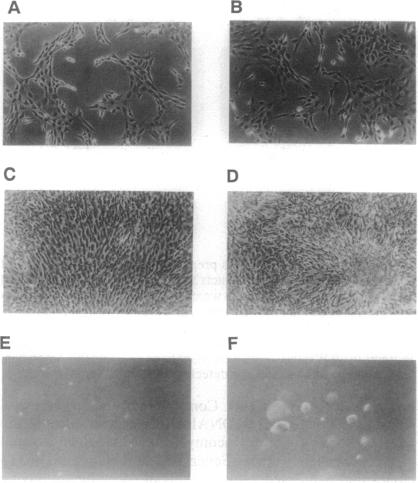
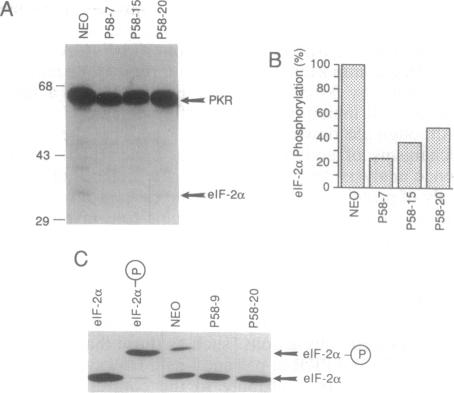
The interferon-induced RNA-dependent protein kinase (PKR) is considered to play an important role in the cellular defense against viral infection and, in addition, has been suggested to be a tumor suppressor gene because of its growth-suppressive properties. Activation of PKR by double-stranded RNAs leads to the phosphorylation of the alpha subunit of eukaryotic initiation factor 2 (eIF-2 alpha) and a resultant block to protein synthesis initiation. To avoid the consequences of kinase activation, many viruses have developed strategies to down-regulate PKR. Recently, we reported on the purification and characterization of a cellular inhibitor of PKR (referred to as p58), which is activated during influenza virus infection. Subsequent cloning and sequencing has revealed that p58 is a member of the tetratricopeptide repeat (TPR) family of proteins. To further examine the physiological role of this PKR inhibitor, we stably transfected NIH 3T3 cells with a eukaryotic expression plasmid containing p58 cDNA under control of the cytomegalovirus early promoter. By taking advantage of a recently characterized p58 species-specific monoclonal antibody, we isolated cell lines that overexpressed p58. These cells exhibited a transformed phenotype, growing at faster rates and higher saturation densities and exhibiting anchorage-independent growth. Most importantly, inoculation of nude mice with p58-overexpressing cells gave rise to the production of tumors. Finally, murine PKR activity and endogenous levels of eIF-2 alpha phosphorylation were reduced in the p58-expressing cell lines compared with control cells. These data, taken together, suggest that p58 functions as an oncogene and that one mechanism by which the protein induces malignant transformation is through the down-regulation of PKR and subsequent deregulation of protein synthesis.
干扰素诱导的RNA依赖性蛋白激酶(PKR)被认为在细胞抵御病毒感染中发挥重要作用,此外,因其具有生长抑制特性,也被认为是一种肿瘤抑制基因。双链RNA激活PKR会导致真核起始因子2(eIF-2α)的α亚基磷酸化,从而阻断蛋白质合成起始。为避免激酶激活的后果,许多病毒已开发出下调PKR的策略。最近,我们报道了PKR的一种细胞抑制剂(称为p58)的纯化和特性,该抑制剂在流感病毒感染期间被激活。随后的克隆和测序表明,p58是四肽重复(TPR)蛋白家族的成员。为进一步研究这种PKR抑制剂的生理作用,我们用一个在巨细胞病毒早期启动子控制下含有p58 cDNA的真核表达质粒稳定转染NIH 3T3细胞。利用最近鉴定的一种p58物种特异性单克隆抗体,我们分离出了过表达p58的细胞系。这些细胞表现出转化表型,生长速度更快,饱和密度更高,并表现出不依赖贴壁的生长。最重要的是,用过量表达p58的细胞接种裸鼠会导致肿瘤产生。最后,与对照细胞相比,表达p58的细胞系中鼠源PKR活性和eIF-2α磷酸化的内源性水平降低。综合这些数据表明,p58作为一种癌基因发挥作用,并且该蛋白诱导恶性转化的一种机制是通过下调PKR以及随后解除对蛋白质合成的调控。