Fernandes Janaina
NUMPEX-BIO, Campus Xerém, Federal University of Rio de Janeiro, Duque de Caxias, Rio de Janeiro, Brazil.; Institute for Translational Research on Health and Environment in the Amazon Region-INPeTAm, Federal University of Rio de Janeiro, Rio de Janeiro, Brazil.
Biomark Cancer. 2016 Jul 28;8:101-10. doi: 10.4137/BIC.S33378. eCollection 2016.
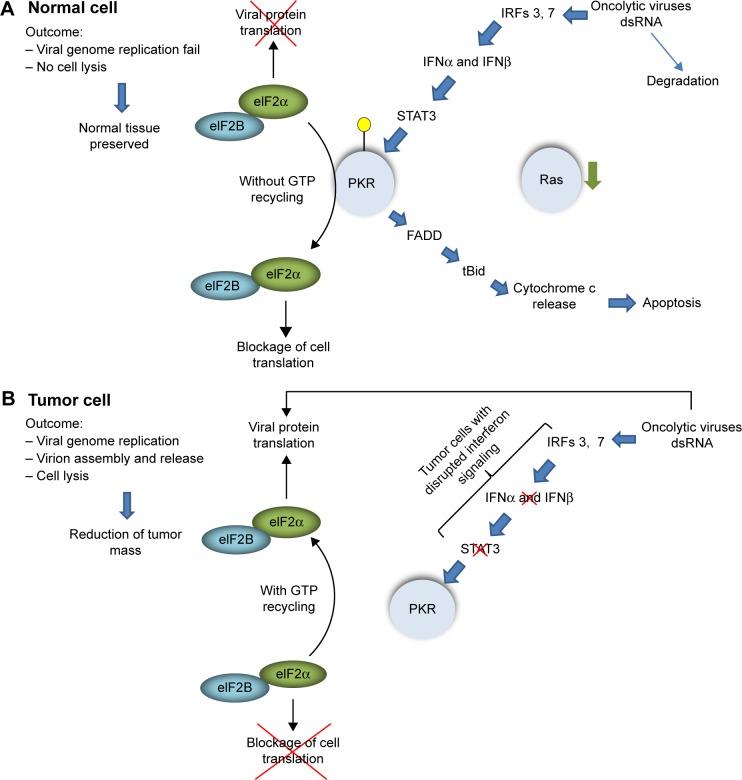
The transforming properties of oncogenes are derived from gain-of-function mutations, shifting cell signaling from highly regulated homeostatic to an uncontrolled oncogenic state, with the contribution of the inactivating mutations in tumor suppressor genes P53 and RB, leading to tumor resistance to conventional and target-directed therapy. On the other hand, this scenario fulfills two requirements for oncolytic virus infection in tumor cells: inactivation of tumor suppressors and presence of oncoproteins, also the requirements to engage malignancy. Several of these oncogenes have a negative impact on the main interferon antiviral defense, the double-stranded RNA-activated protein kinase (PKR), which helps viruses to spontaneously target tumor cells instead of normal cells. This review is focused on the negative impact of overexpression of oncogenes on conventional and targeted therapy and their positive impact on viral oncolysis due to their ability to inhibit PKR-induced translation blockage, allowing virion release and cell death.
癌基因的转化特性源自功能获得性突变,使细胞信号传导从高度调控的稳态状态转变为不受控制的致癌状态,肿瘤抑制基因P53和RB的失活突变也起了作用,导致肿瘤对传统疗法和靶向疗法产生抗性。另一方面,这种情况满足了肿瘤细胞中溶瘤病毒感染的两个条件:肿瘤抑制因子失活和癌蛋白的存在,这也是引发恶性肿瘤的条件。其中一些癌基因对主要的干扰素抗病毒防御机制——双链RNA激活蛋白激酶(PKR)有负面影响,这有助于病毒自发地靶向肿瘤细胞而非正常细胞。本综述聚焦于癌基因过表达对传统疗法和靶向疗法的负面影响,以及因其抑制PKR诱导的翻译阻断、允许病毒粒子释放和细胞死亡的能力而对病毒溶瘤产生的积极影响。