Pollack J R, Ganem D
Department of Biochemistry and Biophysics, University of California Medical Center, San Francisco 94143-0502.
J Virol. 1994 Sep;68(9):5579-87. doi: 10.1128/JVI.68.9.5579-5587.1994.
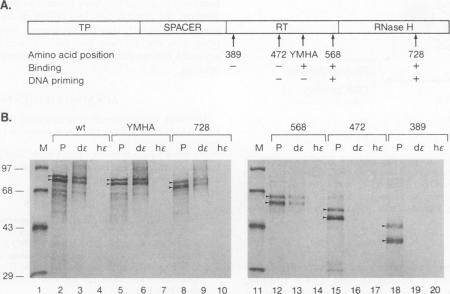
Hepatitis B viruses encode a polymerase (P) protein with key roles in both reverse transcription and genomic RNA encapsidation. Genetic analysis of cis-acting signals required for viral replication implicates an RNA stem-loop structure in both RNA packaging and the initiation of reverse transcription, a process in which P protein also serves as the primer. We now show that duck hepatitis B virus (DHBV) polymerase binds specifically and with high affinity to this RNA stem-loop structure. Mutational analysis indicates that all mutations in the RNA target that inhibit the P protein-RNA interaction inhibit both in vivo RNA packaging and in vitro DNA priming to comparable extents. However, certain mutations in the loop region of the RNA have minimal impact on P protein-RNA binding but are nonetheless severely defective for packaging and DNA synthesis. Thus, P protein-RNA complex formation is necessary but not sufficient to initiate these activities. In addition, examination of RNA binding by truncated P proteins indicates that the C terminus of the polymerase, although required for RNA encapsidation in vivo, is dispensable for RNA binding and DNA priming.
乙型肝炎病毒编码一种聚合酶(P)蛋白,该蛋白在逆转录和基因组RNA衣壳化过程中均发挥关键作用。对病毒复制所需的顺式作用信号进行遗传分析表明,一种RNA茎环结构在RNA包装和逆转录起始过程中均有涉及,在逆转录过程中P蛋白也充当引物。我们现在发现,鸭乙型肝炎病毒(DHBV)聚合酶能特异性且高亲和力地结合这种RNA茎环结构。突变分析表明,RNA靶标中所有抑制P蛋白-RNA相互作用的突变,在体内RNA包装和体外DNA引发方面均受到同等程度的抑制。然而,RNA环区域的某些突变对P蛋白-RNA结合影响极小,但在包装和DNA合成方面却存在严重缺陷。因此,P蛋白-RNA复合物的形成是启动这些活动的必要条件,但并非充分条件。此外,对截短的P蛋白的RNA结合情况进行检测表明,聚合酶的C末端虽然在体内RNA衣壳化过程中是必需的,但在RNA结合和DNA引发方面却是可有可无的。