Falvey E, Fleury-Olela F, Schibler U
Department of Molecular Biology, University of Geneva, Switzerland.
EMBO J. 1995 Sep 1;14(17):4307-17. doi: 10.1002/j.1460-2075.1995.tb00105.x.
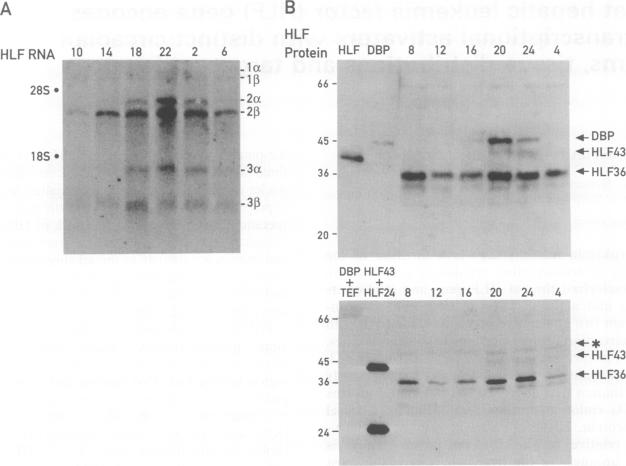
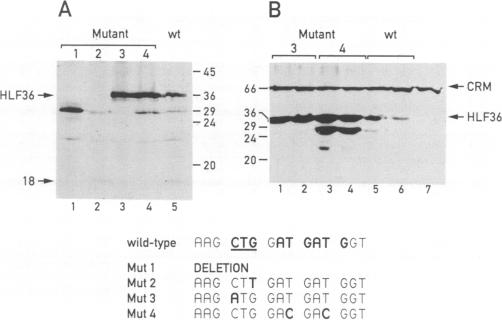
Hepatic leukemia factor (HLF) is a member of the PAR family of transcription regulatory proteins. We have characterized the rat HLF gene and studied its expression and activity. The rat HLF gene is transcribed from two alternative promoters, alpha and beta, with different circadian amplitudes and tissue specificities. The alpha RNA isoforms produce a 43 kDa protein, HLF43, abundant in brain, liver and kidney, like the previously described human HLF RNA. The beta RNA HLF isoforms use a CUG codon to initiate translation of a novel 36 kDa protein, HLF36, which is shorter at its N-terminus relative to the 43 kDa form. HLF36 is expressed uniquely in the liver, where it is the most abundant HLF protein. Surprisingly, the two proteins accumulate in the liver with different circadian amplitudes and have distinct liver-specific promoter preferences in transfection experiments. Thus, HLF43 stimulates transcription from the cholesterol 7 alpha-hydroxylase promoter much more efficiently than from the albumin promoter, while the converse is true for HLF36.
肝白血病因子(HLF)是转录调节蛋白PAR家族的成员。我们已经对大鼠HLF基因进行了表征,并研究了其表达和活性。大鼠HLF基因由两个不同的启动子α和β转录,具有不同的昼夜节律幅度和组织特异性。αRNA异构体产生一种43 kDa的蛋白HLF43,在脑、肝和肾中含量丰富,类似于先前描述的人类HLF RNA。βRNA HLF异构体使用CUG密码子起始一种新型36 kDa蛋白HLF36的翻译,该蛋白相对于43 kDa形式在其N端较短。HLF36仅在肝脏中表达,是肝脏中最丰富的HLF蛋白。令人惊讶的是,这两种蛋白在肝脏中以不同的昼夜节律幅度积累,并且在转染实验中具有不同的肝脏特异性启动子偏好。因此,HLF43比白蛋白启动子更有效地刺激胆固醇7α-羟化酶启动子的转录,而HLF36则相反。