Payne A P
Department of Anatomy, Glasgow University, Scotland, UK.
J Anat. 1994 Aug;185 ( Pt 1)(Pt 1):1-49.
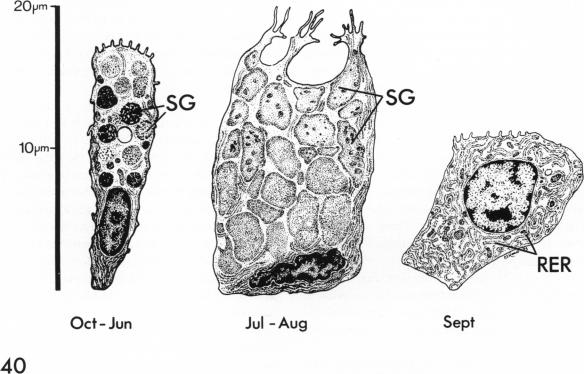
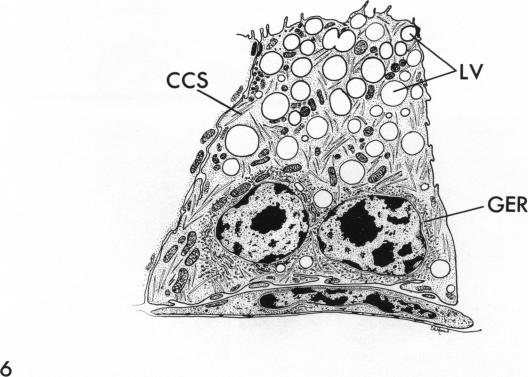
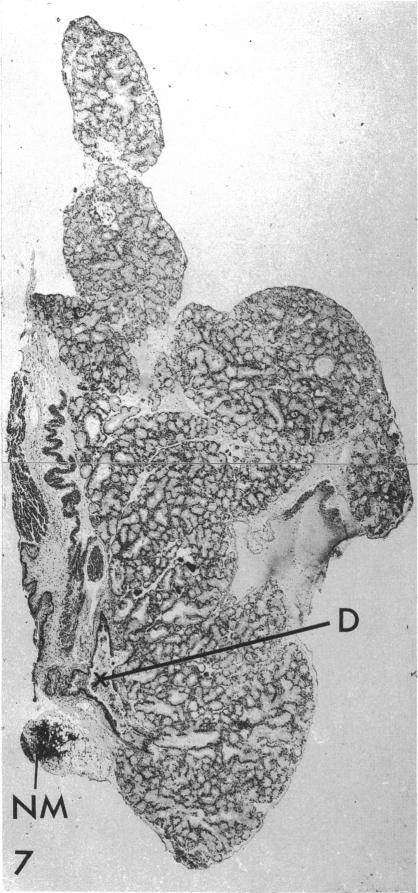
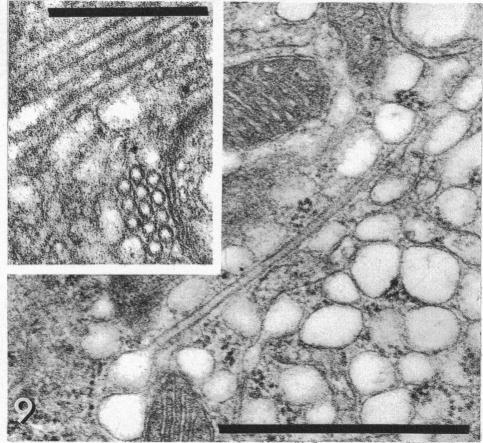
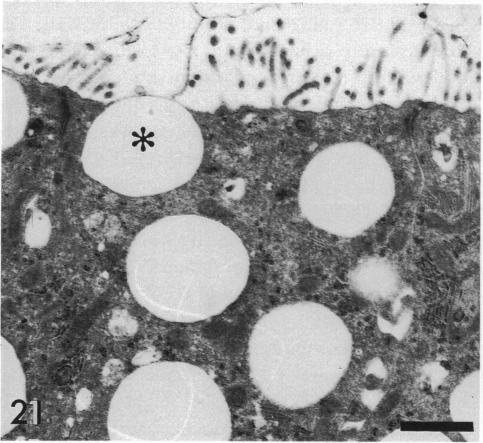
The harderian gland was first described in 1694 by Johann Jacob Harder (1656-1711). It occurs in most terrestrial vertebrates and is located within the orbit where, in some species, it is the largest structure. It may be compound tubular or compound tubuloalveolar, and its secretory duct is usually morphologically distinct only after leaving the substance of the gland to open on the surface of the nictitating membrane. The tubules of the gland are formed of a single layer of columnar epithelial cells surrounded by myoepithelial cells. The chief product(s) of the gland varies between different groups of vertebrates, and epithelial cells possess granules or vacuoles whose contents may be mucous, serous or lipid. In rodents, the gland synthesises lipids, porphyrins and indoles. In the case of lipid vacuoles, the gland is unusual in releasing these by an exocytotic mechanism. It is unclear whether the gland can act both as an exocrine and endocrine organ. There is control of gland structure and synthesis through a variety of humoral agents, including gonadal, thyroid and pituitary hormones; in addition there is a rich autonomic innervation and many neuropeptides have been identified. The proposed functions of the gland are remarkably diverse and include the gland being (1) a source of 'saliva', (2) a site of immune response, (3) a photoprotective organ, (4) part of a retinal-pineal axis, (5) a source of pheromones, (6) a source of thermoregulatory lipids, (7) a site of osmoregulation, and (8) a source of growth factors. The gland is discussed in terms of its embryology and phylogeny, and in relation to ecological variables. Several goals of future research are identified.
哈德氏腺于1694年由约翰·雅各布·哈德(1656 - 1711)首次描述。它存在于大多数陆生脊椎动物中,位于眼眶内,在某些物种中,它是眼眶内最大的结构。它可能是复管泡状腺或复管泡状腺泡状腺,其分泌导管通常仅在离开腺体实质并开口于瞬膜表面后在形态上才明显不同。腺体的小管由单层柱状上皮细胞构成,周围环绕着肌上皮细胞。腺体的主要产物在不同的脊椎动物类群中有所不同,上皮细胞含有颗粒或液泡,其内容物可能是黏液、浆液或脂质。在啮齿动物中,该腺体合成脂质、卟啉和吲哚。就脂质液泡而言,该腺体通过胞吐机制释放它们的方式很不寻常。尚不清楚该腺体是否既能作为外分泌器官又能作为内分泌器官发挥作用。通过多种体液因子,包括性腺、甲状腺和垂体激素,对腺体的结构和合成进行调控;此外,还有丰富的自主神经支配,并且已鉴定出许多神经肽。该腺体的推测功能非常多样,包括(1)“唾液”来源,(2)免疫反应场所,(3)光保护器官,(4)视网膜 - 松果体轴的一部分,(5)信息素来源,(6)体温调节脂质来源,(7)渗透调节场所,以及(8)生长因子来源。本文从其胚胎学和系统发育以及与生态变量的关系方面对该腺体进行了讨论。确定了未来研究的几个目标。