DiGiuseppe J A, Redston M S, Yeo C J, Kern S E, Hruban R H
Department of Pathology, Johns Hopkins Medical Institutions, Baltimore, Maryland 21287-6417, USA.
Am J Pathol. 1995 Oct;147(4):884-8.
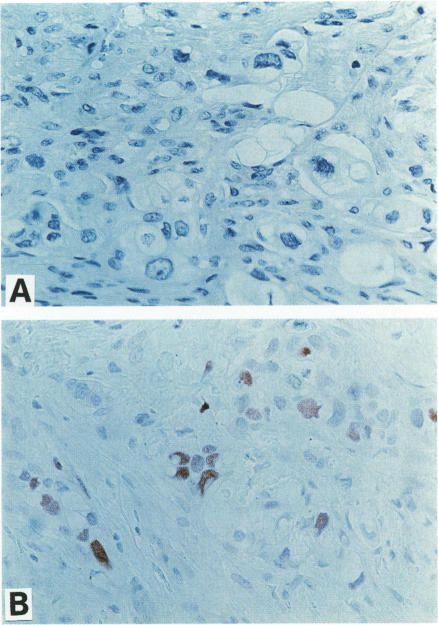
The p53 tumor suppressor gene is mutated in the majority of pancreatic adenocarcinomas, and several studies have suggested that loss of p53 function may contribute to the aggressive clinical behavior of pancreas cancer. Although immunocytochemical accumulation of the p53 gene product has previously been assessed as a marker for p53 mutations in cancers of the pancreas and other organ systems, the relationship between p53 mutations and p53 protein accumulation is variable. The cyclin-dependent kinase inhibitor, p21 (also known as WAF1 and CIP1), is induced by wild-type but not mutant p53, and recent work has implicated p21 as a downstream mediator of the growth-suppressing and apoptosis-promoting functions of wild-type p53. In the present work, we sought to determine whether loss of p21 expression could more precisely identify those tumors with p53 mutations and/or loss, compared with immunocytochemical assessment of p53 protein accumulation. We evaluated p53 and p21 expression immunohistochemically in a series of 21 ductal adenocarcinomas of the pancreas with known p53 mutational status. Diffuse overexpression of p53 was found in 3 of 8 cases (38%) with wild-type p53 and 7 of 13 cases (54%) with p53 mutations with or without loss of heterozygosity at 17p. Surprisingly, expression of p21 correlated neither with p53 mutational status nor with p53 protein expression. In particular, strong p21 expression was seen even in carcinomas in which molecular analysis revealed a frameshift mutation in one allele of p53 and loss of the second. These data suggest that p21 expression in pancreatic adenocarcinoma may also be induced by a p53-independent pathway and that p21 expression, as assessed immunocytochemically, does not reflect the functional status of p53 in these carcinomas.
p53肿瘤抑制基因在大多数胰腺腺癌中发生突变,多项研究表明,p53功能丧失可能促使胰腺癌呈现侵袭性临床行为。尽管此前已将p53基因产物的免疫细胞化学积聚评估为胰腺癌及其他器官系统癌症中p53突变的标志物,但p53突变与p53蛋白积聚之间的关系并不稳定。细胞周期蛋白依赖性激酶抑制剂p21(也称为WAF1和CIP1)由野生型而非突变型p53诱导产生,最近的研究表明p21是野生型p53生长抑制和促凋亡功能的下游介质。在本研究中,我们试图确定与p53蛋白积聚的免疫细胞化学评估相比,p21表达缺失是否能更准确地识别那些存在p53突变和/或缺失的肿瘤。我们采用免疫组织化学方法评估了21例已知p53突变状态的胰腺导管腺癌中p53和p21的表达情况。在8例野生型p53的病例中,有3例(38%)出现p53弥漫性过表达;在13例存在p53突变且伴有或不伴有17p杂合性缺失的病例中,有7例(54%)出现p53弥漫性过表达。令人惊讶的是,p21的表达既与p53突变状态无关,也与p53蛋白表达无关。特别是,即使在分子分析显示p53一个等位基因发生移码突变且另一个等位基因缺失的癌组织中,也观察到了强烈的p21表达。这些数据表明,胰腺腺癌中p21的表达也可能由p53非依赖性途径诱导,并且通过免疫细胞化学评估的p21表达并不能反映这些癌组织中p53的功能状态。