
早期神经影像学、脉冲多普勒及神经生理学对足月缺氧缺血性脑病患儿的预测价值
Predictive value of early neuroimaging, pulsed Doppler and neurophysiology in full term infants with hypoxic-ischaemic encephalopathy.
作者信息
Eken P, Toet M C, Groenendaal F, de Vries L S
机构信息
Department of Neonatology, Wilhelmina Children's Hospital, Utrecht, The Netherlands.
出版信息
Arch Dis Child Fetal Neonatal Ed. 1995 Sep;73(2):F75-80. doi: 10.1136/fn.73.2.f75.
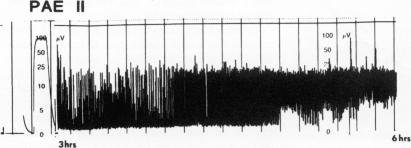
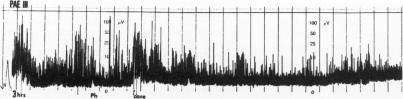
To evaluate their prognostic value, five different non-invasive techniques were used on 34 full term infants with hypoxic-ischaemic encephalopathy (HIE) within six hours of delivery. Cranial ultrasonography, the resistance index (RI) of the middle cerebral artery obtained with Doppler ultrasonography, somatosensory evoked potentials (SEPs), visual evoked potentials (VEPs) and the cerebral function monitor (CFM) were used. According to the criteria of Sarnat, 11 infants developed mild, seven moderate, and 16 severe encephalopathy. The CFM had the highest positive (PPV 84.2%) and negative predictive value (NPV 91.7%). All but one of the infants with a continuous pattern had a good outcome. The CFM of 11 cases with a suppression-burst pattern changed to a continuous pattern over 24 to 48 hours in four infants, and was associated with a normal outcome in three. All five cases with an isoelectric CFM died. The SEPs also provided useful information (PPV 81.8%; NPV 91.7%). VEPs were often delayed during the first hours or life and did not carry a poor prognosis in five of 14 cases (PPV 77.3%). Both ultrasonography and Doppler RI were of little value, as they were almost always normal at this early stage. In 34 full term infants with HIE, studied within 6 hours of life, the CFM and SEPs provided the most useful information about the expected course of encephalopathy and subsequent neurodevelopmental outcome.
为评估其预后价值,在34例足月缺氧缺血性脑病(HIE)患儿出生后6小时内使用了五种不同的非侵入性技术。采用了头颅超声检查、经多普勒超声获得的大脑中动脉阻力指数(RI)、体感诱发电位(SEP)、视觉诱发电位(VEP)和脑功能监测仪(CFM)。根据萨纳特标准,11例患儿发生轻度脑病,7例为中度,16例为重度。CFM具有最高的阳性预测值(PPV 84.2%)和阴性预测值(NPV 91.7%)。除1例持续模式的患儿外,其余所有患儿预后良好。11例呈抑制-爆发模式的患儿中,有4例在24至48小时内CFM转变为持续模式,其中3例预后正常。CFM呈电静止的5例患儿均死亡。SEP也提供了有用信息(PPV 81.8%;NPV 91.7%)。VEP在出生后最初数小时常延迟,14例中有5例预后不差(PPV 77.3%)。超声检查和多普勒RI价值不大,因为在这个早期阶段它们几乎总是正常的。在34例出生后6小时内研究的足月HIE患儿中,CFM和SEP提供了关于脑病预期病程及随后神经发育结局的最有用信息。

 Zotero 插件