Boocock M R, Zhu X, Grindley N D
Department of Molecular Biophysics and Biochemistry, Yale University, Bass Center for Molecular and Structural Biology, New Haven, CT 06520-8114, USA.
EMBO J. 1995 Oct 16;14(20):5129-40. doi: 10.1002/j.1460-2075.1995.tb00195.x.
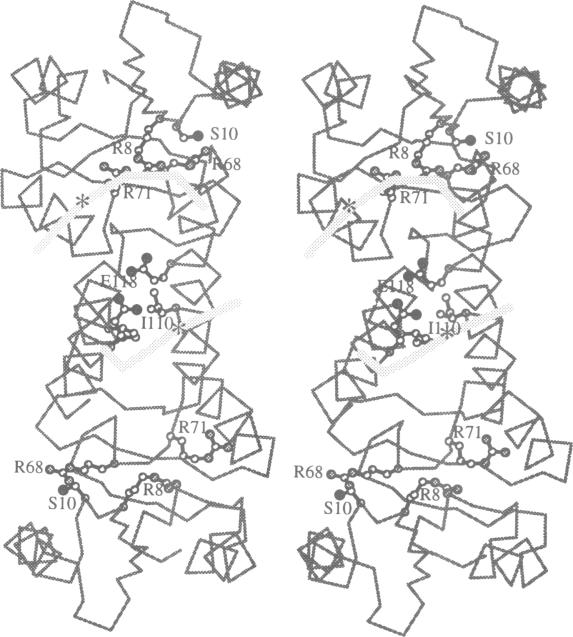
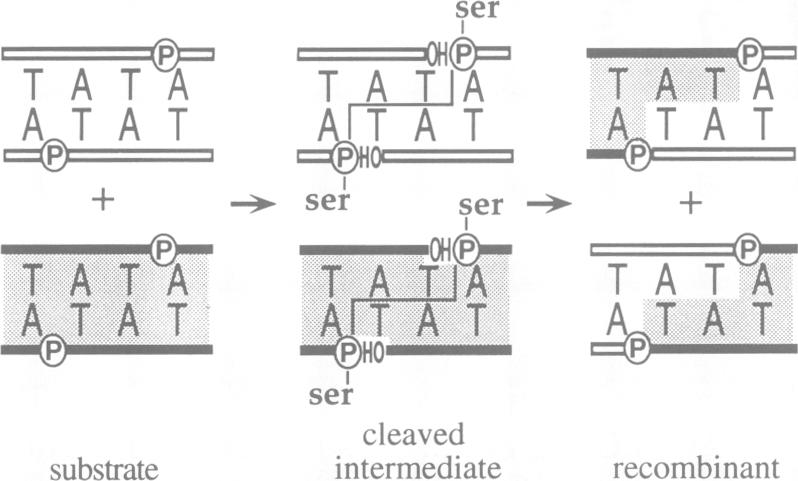
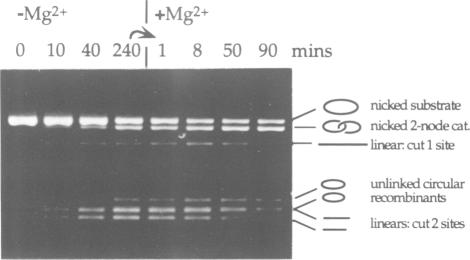
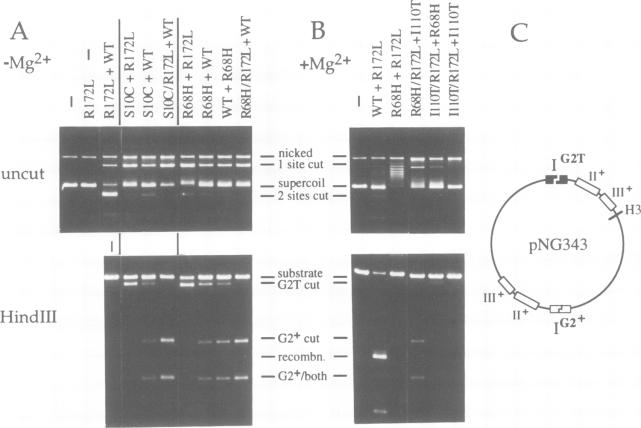
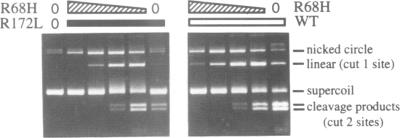
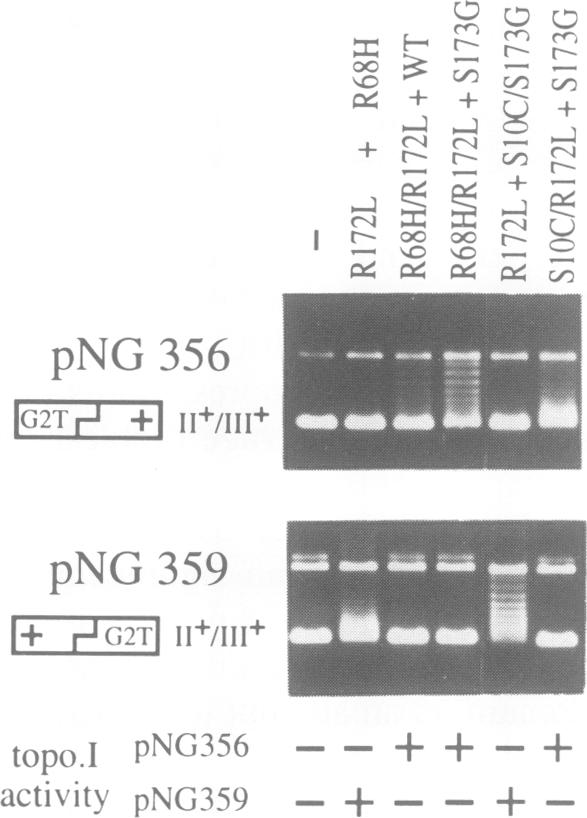
The resolvase protein of the gamma delta transposon is a site-specific recombinase that acts by a concerted break-and-join mechanism. To analyse the role of individual resolvase subunits in DNA strand cleavage, we have directed the binding of catalytic mutants to specific recombination crossover sites or half-sites. Our results demonstrate that the resolvase subunit bound at the half-site proximal to each scissile phosphodiester bond provides the Ser10 nucleophile and Arg8, Arg68 and Arg71 residues essential for cleavage and covalent attachment to the DNA. Several other residues near the presumptive active site are also shown to act in cis. Double-strand cleavage at one crossover site can proceed independently of cleavage at the other site, although interactions between the resolvase dimers bound at the two crossover sites remain essential. An appropriately oriented heterodimer of active and inactive protomers can in most cases mediate either a 'top' or 'bottom' single-strand cleavage, suggesting that there is no obligatory order of strand cleavages. Top-strand cleavage is associated with the topoisomerase I activity of resolvase, suggesting that a functional asymmetry may be imposed on the crossover site by the structure of the active synapse.
γδ转座子的解离酶蛋白是一种位点特异性重组酶,通过协同的断裂和连接机制发挥作用。为了分析单个解离酶亚基在DNA链切割中的作用,我们已引导催化突变体与特定的重组交叉位点或半位点结合。我们的结果表明,结合在每个可切割磷酸二酯键近端半位点的解离酶亚基提供了Ser10亲核试剂以及切割和与DNA共价连接所必需的Arg8、Arg68和Arg71残基。假定活性位点附近的其他几个残基也显示出顺式作用。一个交叉位点的双链切割可以独立于另一个位点的切割进行,尽管结合在两个交叉位点的解离酶二聚体之间的相互作用仍然至关重要。在大多数情况下,活性和非活性原体的适当定向异二聚体可以介导“顶部”或“底部”单链切割,这表明链切割没有必然的顺序。顶部链切割与解离酶的拓扑异构酶I活性相关,这表明活性突触的结构可能会在交叉位点上施加功能不对称性。