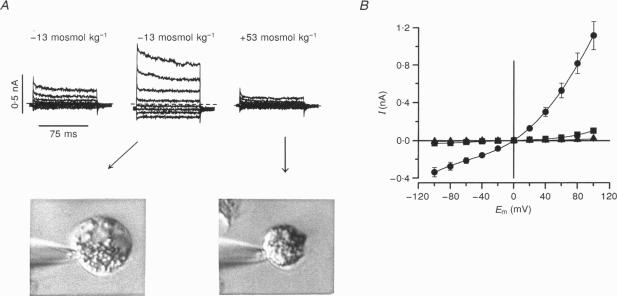
Rat parotid acinar cells undergo a regulatory volume decrease in response to hypotonically induced cell swelling that is sensitive to K+ and Cl- gradients. To investigate the potential mechanisms involved, the whole-cell patch-clamp technique was used to characterize a volume-sensitive Cl- channel in rat parotid acinar cells. 2. Exposure of cells to a hyposmotic gradient induced large Cl- currents that exhibited outward rectification and were not affected by membrane potential or the absence of intracellular Ca2+. Low external pH increased the currents at all potentials without affecting current kinetics. These currents were nearly abolished when the cells were in hypertonic conditions. This decrease in the current amplitude was correlated with a decrease in the cell size. 3. The volume-sensitive currents displayed little or no time dependence, whereas Ca(2+)-activated Cl- channels, present in the same cells, displayed slow activation kinetics and large, time-dependent tail currents upon repolarization to the holding potential. 4. The reversal potential of the osmotically activated channels was close to the predicted chloride equilibrium potential and was sensitive to the physiological extracellular Cl- concentration ([Cl-]o). The relationship between reversal potential and [Cl-]o was fitted to a modified Nernst equation with a slope of 51 mV per decade, consistent with a Cl- selective conductance. 5. The anion permeability sequence of the channel, obtained from the shifts of the reversal potentials of the volume-sensitive Cl- current, was: SCN- > I- > NO-3 > Br- > Cl- > formate > propionate = methanesulphonate = acetate > or = F- > or = butyrate > valerate > gluconate = glucuronate = glutamate. 6. The current through the volume-sensitive channels was inhibited by the Cl- channel blocker SITS (4-acetamido-4'-isothiocyanatostilbene-2,2'-disulphonic acid) in a voltage-dependent manner. 7. We conclude that rat parotid acinar cells express an outwardly rectifying Cl- current that can be activated by swelling under hypotonic conditions. This Cl- conductance may be an element of the cellular mechanisms of volume regulation in exocrine glands.