Kitabayashi I, Eckner R, Arany Z, Chiu R, Gachelin G, Livingston D M, Yokoyama K K
Tsukuba Life Science Center, The Institute of Physical and Chemical Research Riken, Japan.
EMBO J. 1995 Jul 17;14(14):3496-509. doi: 10.1002/j.1460-2075.1995.tb07356.x.
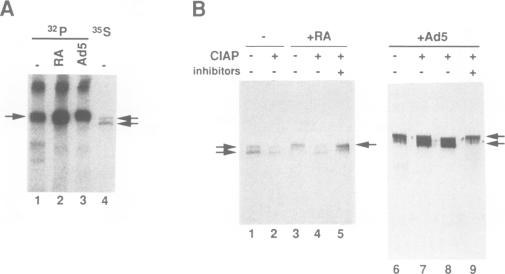
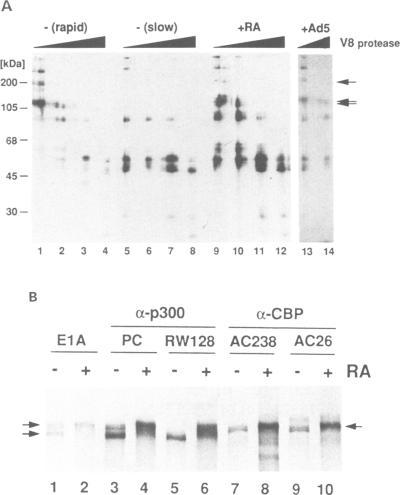
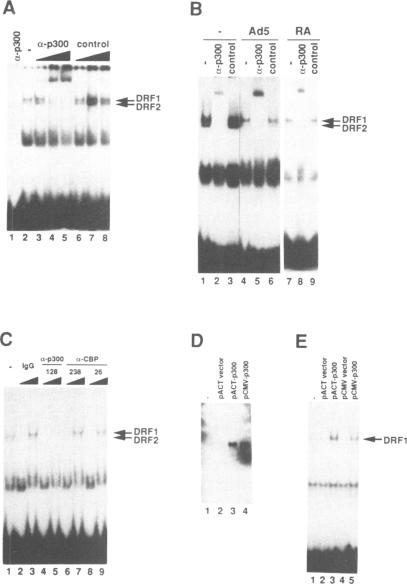
Transcription of the c-jun gene is up-regulated by either retinoic acid (RA) or adenovirus E1A during the differentiation of F9 cells. We show here that RA and E1A induce phosphorylation of the E1A-associated 300 kDa protein (p300) during the differentiation of F9 cells. The region of E1A that is required for interaction with cellular protein p300 overlaps with the region of E1A required for E1A to induce expression of the c-jun gene. Treatment of F9 cells with RA or infection of the cells by adenovirus led to a decrease in the electrophoretic mobility of p300. Phosphatase treatment of p300 from RA-treated or adenovirus-infected F9 cells reversed the changes in migration of p300, indicating that RA- and E1A-mediated changes in the mobility of p300 were due to phosphorylation. We also found factors, designated DRF1 and DRF2, that bound specifically to a sequence element that is necessary and sufficient for RA- and E1A-mediated up-regulation of the c-jun gene. The mobility of DRF complexes was changed by E1A or RA and the complexes were supershifted by addition of a polyclonal p300 antiserum. Moreover, overexpression of p300 resulted in an increase in the level of DRF1 complex. p300 fused to the DNA binding domain of the E2 protein of papilloma virus stimulated E2-dependent reporter activity in response to RA or E1A in F9 cells. Our results suggest that p300 is part of the DRF complexes, that it is differentially phosphorylated in undifferentiated versus differentiated cells and that it is likely involved in regulating transcription of the c-jun gene during F9 cell differentiation.
在F9细胞分化过程中,视黄酸(RA)或腺病毒E1A均可上调c-jun基因的转录。我们在此表明,在F9细胞分化过程中,RA和E1A可诱导E1A相关的300 kDa蛋白(p300)磷酸化。E1A与细胞蛋白p300相互作用所需的区域与E1A诱导c-jun基因表达所需的区域重叠。用RA处理F9细胞或用腺病毒感染细胞会导致p300的电泳迁移率降低。用磷酸酶处理来自经RA处理或腺病毒感染的F9细胞的p300可逆转p300迁移的变化,这表明RA和E1A介导的p300迁移变化是由于磷酸化所致。我们还发现了名为DRF1和DRF2的因子,它们特异性结合到一个对RA和E1A介导的c-jun基因上调既必要又充分的序列元件上。DRF复合物的迁移率因E1A或RA而改变,并且通过添加多克隆p300抗血清可使复合物发生超迁移。此外,p300的过表达导致DRF1复合物水平增加。与乳头瘤病毒E2蛋白的DNA结合结构域融合的p300可刺激F9细胞中对RA或E1A产生反应的E2依赖性报告基因活性。我们的结果表明,p300是DRF复合物的一部分,它在未分化细胞与分化细胞中存在差异磷酸化,并且它可能在F9细胞分化过程中参与调节c-jun基因的转录。