Davis D R, Brion J P, Couck A M, Gallo J M, Hanger D P, Ladhani K, Lewis C, Miller C C, Rupniak T, Smith C
Department of Neuroscience, Institute of Psychiatry, London, UK.
Biochem J. 1995 Aug 1;309 ( Pt 3)(Pt 3):941-9. doi: 10.1042/bj3090941.
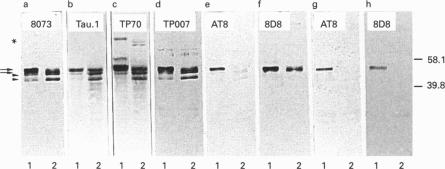
The effects of the excitatory amino acid glutamate, the microtubule destabilizing agent colchicine, and beta 25-35-amyloid peptide on the phosphorylation state of tau were studied in rat cortical neurons in primary culture. Using immunocytochemistry and Western-blot analysis, we demonstrated that a proportion of tau in these cultures is normally highly phosphorylated, but most of this tau fraction is dephosphorylated after treatment of the cultures with glutamate or colchicine, but not with beta-amyloid; the glutamate- and colchicine-induced changes in tau phosphorylation commenced before cell death, as assessed by release of lactate dehydrogenase. Dephosphorylation of tau was readily revealed by using the monoclonal antibodies Tau.1 and AT8, which have phosphate-sensitive epitopes that both centre around serine-199 and -202 (numbering of the largest tau isoform). On Western blots and by immunocytochemistry, AT8 labelling strongly decreased after glutamate and colchicine treatments, whereas Tau.1 staining was more intense. Neurofilament monoclonal antibodies, including RT97, 8D8, SMI31 and SMI310, all additionally known to recognize tau in a phosphorylation-dependent manner, also demonstrated that glutamate and colchicine treatments of the cultures induced a dephosphorylation of tau. We also showed immunocytochemically that there is an increase in tau immunoreactivity in neuronal perikarya in response to glutamate and colchicine treatment, and this occurs concomitantly with the dephosphorylation of tau. Treatment of the primary rat cortical neuronal cultures with beta 25-35-amyloid peptide, under conditions which induce neuronal degeneration, did not induce a change in tau phosphorylation, and failed to act synergistically with glutamate to produce an increase in dephosphorylation of tau over that produced by glutamate treatment alone. These findings demonstrate that glutamate and colchicine induce tau dephosphorylation, as opposed to increased tau phosphorylation, which would be more indicative of Alzheimer-type neurodegeneration.
在原代培养的大鼠皮质神经元中,研究了兴奋性氨基酸谷氨酸、微管去稳定剂秋水仙碱和β25 - 35淀粉样肽对tau蛋白磷酸化状态的影响。通过免疫细胞化学和蛋白质免疫印迹分析,我们证明在这些培养物中,一部分tau蛋白通常高度磷酸化,但在用谷氨酸或秋水仙碱处理培养物后,大部分这种磷酸化的tau蛋白会去磷酸化,而用β淀粉样肽处理则不会;通过乳酸脱氢酶释放评估,谷氨酸和秋水仙碱诱导的tau蛋白磷酸化变化在细胞死亡之前就已开始。使用单克隆抗体Tau.1和AT8很容易检测到tau蛋白的去磷酸化,这两种抗体具有对磷酸敏感的表位,都以丝氨酸 - 199和 - 202(最大tau异构体的编号)为中心。在蛋白质免疫印迹和免疫细胞化学中,谷氨酸和秋水仙碱处理后,AT8标记显著减少,而Tau.1染色更强烈。神经丝单克隆抗体,包括RT97、8D8、SMI31和SMI310,已知它们也以磷酸化依赖的方式识别tau蛋白,同样表明谷氨酸和秋水仙碱处理培养物会诱导tau蛋白去磷酸化。我们还通过免疫细胞化学表明,谷氨酸和秋水仙碱处理后,神经元胞体中tau蛋白免疫反应性增加,并且这与tau蛋白的去磷酸化同时发生。在诱导神经元变性的条件下,用β25 - 35淀粉样肽处理原代大鼠皮质神经元培养物,不会诱导tau蛋白磷酸化的变化,但不能与谷氨酸协同作用,使tau蛋白的去磷酸化程度超过单独用谷氨酸处理所产生的程度。这些发现表明,谷氨酸和秋水仙碱诱导tau蛋白去磷酸化,而不是增加tau蛋白磷酸化,增加tau蛋白磷酸化更表明是阿尔茨海默型神经退行性变。