Eijdems E W, Zaman G J, de Haas M, Versantvoort C H, Flens M J, Scheper R J, Kamst E, Borst P, Baas F
Division of Molecular Biology, The Netherlands Cancer Institute, Amsterdam.
Br J Cancer. 1995 Aug;72(2):298-306. doi: 10.1038/bjc.1995.328.
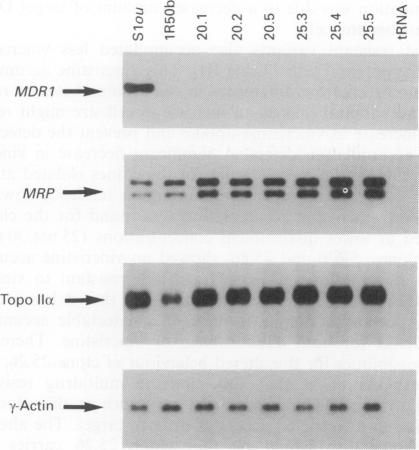
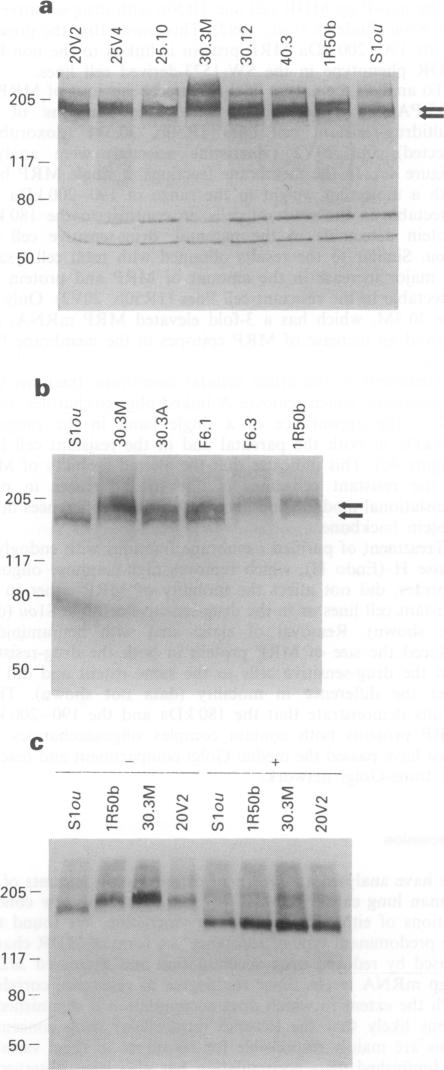
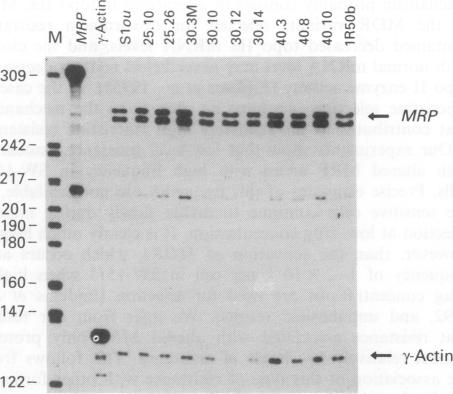
We have analysed the contribution of several parameters, e.g. drug accumulation, MDR1 P-glycoprotein (P-gp), multidrug resistance-associated protein (MRP) and topoisomerase (topo) II, to drug resistance in a large set of drug-resistant variants of the human non-small-cell lung cancer cell line SW-1573 derived by selection with low concentrations of doxorubicin or vincristine. Selection with either drug nearly always resulted in MDR clones. The resistance of these clones could be explained by reduced drug accumulation and was associated with a decrease rather than an increase in the low MDR1 mRNA level. To test whether a decrease in MDR1 mRNA indirectly affected resistance in these cells, we introduced a MDR1-specific hammerhead ribozyme into wild-type SW-1573 cells. Although this led to a substantial reduction in MDR1 mRNA, it did not result in resistance. In all resistant clones we found an altered form of the multidrug resistance-associated protein (MRP), migrating slightly slower during SDS-polyacrylamide gel electrophoresis than MRP in parental cells. This altered MRP was also present in non-P-gp MDR somatic cell hybrids of the SW-1573 cells, demonstrating a clear linkage with the MDR phenotype. Treatment of crude cellular membrane fractions with N-glycanase, endoglycosidase H or neuraminidase showed that the altered migration of MRP on SDS-PAGE is due to a post-translational modification. There was no detectable difference in sialic acid content. In most but not all doxorubicin-selected clones, this MDR phenotype was accompanied by a reduction in topo II alpha mRNA level. No reduction was found in the clones selected with vincristine. We conclude from these results that selection of the SW-1573 cell line for low levels of doxorubicin or vincristine resistance, predominantly results in MDR with reduced drug accumulation associated with the presence of an altered MRP protein. This mechanism can be accompanied by other resistance mechanisms, such as reduced topo II alpha mRNA in case of doxorubicin selection.
我们分析了几个参数对人非小细胞肺癌细胞系SW - 1573大量耐药变体耐药性的贡献,这些参数包括药物蓄积、多药耐药蛋白1(MDR1)P - 糖蛋白(P - gp)、多药耐药相关蛋白(MRP)和拓扑异构酶(topo)II,该细胞系是通过用低浓度阿霉素或长春新碱筛选得到的。用这两种药物中的任何一种进行筛选几乎总是产生多药耐药克隆。这些克隆的耐药性可以用药物蓄积减少来解释,并且与低水平的MDR1 mRNA水平降低而非升高有关。为了测试MDR1 mRNA的降低是否间接影响这些细胞的耐药性,我们将一种MDR1特异性锤头状核酶导入野生型SW - 1573细胞。尽管这导致MDR1 mRNA大幅降低,但并未产生耐药性。在所有耐药克隆中,我们发现了一种多药耐药相关蛋白(MRP)的改变形式,在十二烷基硫酸钠 - 聚丙烯酰胺凝胶电泳(SDS - PAGE)中其迁移速度比亲本细胞中的MRP略慢。这种改变的MRP也存在于SW - 1573细胞的非P - gp多药耐药体细胞杂种中,表明与多药耐药表型有明确的联系。用N - 聚糖酶、内切糖苷酶H或神经氨酸酶处理粗细胞膜组分表明,MRP在SDS - PAGE上迁移的改变是由于翻译后修饰。唾液酸含量没有可检测到的差异。在大多数但并非所有阿霉素筛选的克隆中,这种多药耐药表型伴随着拓扑异构酶IIα(topo IIα)mRNA水平的降低。在用长春新碱筛选的克隆中未发现降低。从这些结果我们得出结论,选择对低水平阿霉素或长春新碱耐药的SW - 1573细胞系,主要导致多药耐药,其药物蓄积减少与改变的MRP蛋白的存在有关。这种机制可能伴随着其他耐药机制,如在阿霉素筛选情况下拓扑异构酶IIαmRNA的减少。