Yamanaka S, Balestra M E, Ferrell L D, Fan J, Arnold K S, Taylor S, Taylor J M, Innerarity T L
Gladstone Institute of Cardiovascular Disease, San Francisco, CA 94141-9100, USA.
Proc Natl Acad Sci U S A. 1995 Aug 29;92(18):8483-7. doi: 10.1073/pnas.92.18.8483.
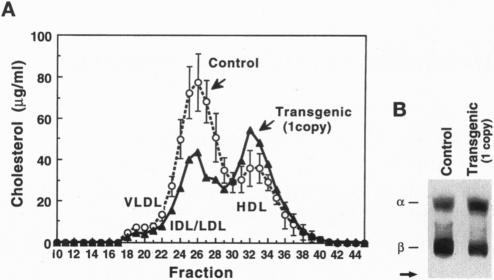
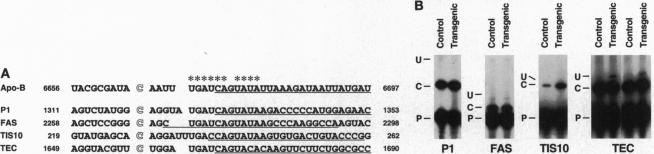
Apolipoprotein (apo-) B mRNA editing is the deamination of cytidine that creates a new termination codon and produces a truncated version of apo-B (apo-B48). The cytidine deaminase catalytic subunit [apo-B mRNA-editing enzyme catalytic polypeptide 1 (APOBEC-1)] of the multiprotein editing complex has been identified. We generated transgenic rabbits and mice expressing rabbit APOBEC-1 in their livers to determine whether hepatic expression would lower low density lipoprotein cholesterol concentrations. The apo-B mRNA from the livers of the transgenic mice and rabbit was extensively edited, and the transgenic animals had reduced concentrations of apo-B100 and low density lipoproteins compared with control animals. Unexpectedly, all of the transgenic mice and a transgenic rabbit had liver dysplasia, and many transgenic mice developed hepatocellular carcinomas. Many of the mouse livers were hyperplastic and filled with lipid. Other hepatic mRNAs with sequence motifs similar to apo-B mRNA were examined for this type of editing (i.e., cytidine deamination). One of these, tyrosine kinase, was edited in livers of transgenic mice but not of controls. This result demonstrates that other mRNAs can be edited by the overexpressed editing enzyme and suggests that aberrant editing of hepatic mRNAs involved in cell growth and regulation is the cause of the tumorigenesis. Finally, these findings compromise the potential use of APOBEC-1 for gene therapy to lower plasma levels of low density lipoproteins.
载脂蛋白(apo-)B信使核糖核酸(mRNA)编辑是胞嘧啶脱氨基作用,可产生一个新的终止密码子,并生成截短形式的apo-B(apo-B48)。已鉴定出多蛋白编辑复合物的胞嘧啶脱氨酶催化亚基[apo-B mRNA编辑酶催化多肽1(APOBEC-1)]。我们培育了在肝脏中表达兔APOBEC-1的转基因兔和小鼠,以确定肝脏表达是否会降低低密度脂蛋白胆固醇浓度。转基因小鼠和兔肝脏中的apo-B mRNA被广泛编辑,与对照动物相比,转基因动物的apo-B100和低密度脂蛋白浓度降低。出乎意料的是,所有转基因小鼠和一只转基因兔都出现了肝脏发育异常,许多转基因小鼠还发生了肝细胞癌。许多小鼠肝脏增生并充满脂质。研究了其他具有与apo-B mRNA相似序列基序的肝脏mRNA是否存在这种类型的编辑(即胞嘧啶脱氨基作用)。其中之一,酪氨酸激酶,在转基因小鼠肝脏中发生了编辑,而在对照小鼠肝脏中未发生编辑。这一结果表明,其他mRNA也可被过表达的编辑酶编辑,并提示参与细胞生长和调控的肝脏mRNA的异常编辑是肿瘤发生的原因。最后,这些发现削弱了将APOBEC-1用于基因治疗以降低血浆低密度脂蛋白水平的可能性。