McCaskill J S, Bauer G J
Max-Planck-Institut für Biophysikalische Chemie, Göttingen, Federal Republic of Germany.
Proc Natl Acad Sci U S A. 1993 May 1;90(9):4191-5. doi: 10.1073/pnas.90.9.4191.
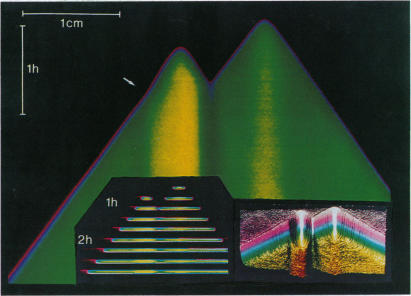
Self-replicating molecules set up traveling concentration waves that propagate in an aqueous enzyme solution. The velocity of each wave provides an accurate (+/- 0.1%) noninvasive measure of fitness for the RNA species currently growing in its front. Evolution may be followed from changes in the front velocity, and these differ from wave to wave. Thousands of controlled evolution reactions in traveling waves have been monitored in parallel to obtain quantitative images of the stochastic process of natural selection. An RNA polymerase (RNA-dependent RNA nucleotidyltransferase, EC 2.7.7.6), extracted from bacteria infected by the Q beta RNA virus, catalyzes the replication. The traveling waves that arise spontaneously without added RNA provide a model system for major evolutionary change.
自我复制分子会形成在水性酶溶液中传播的移动浓度波。每个波的速度为当前在其前沿生长的RNA物种的适应性提供了精确(±0.1%)的非侵入性测量方法。可以通过前沿速度的变化追踪进化过程,并且这些变化在不同波之间存在差异。已经并行监测了数千个移动波中的受控进化反应,以获得自然选择随机过程的定量图像。从被QβRNA病毒感染的细菌中提取的一种RNA聚合酶(RNA依赖性RNA核苷酸转移酶,EC 2.7.7.6)催化复制过程。在不添加RNA的情况下自发产生的移动波为重大进化变化提供了一个模型系统。