Vaux D L, Weissman I L
Department of Pathology, Stanford University Medical Center, California 94305.
Mol Cell Biol. 1993 Nov;13(11):7000-5. doi: 10.1128/mcb.13.11.7000-7005.1993.
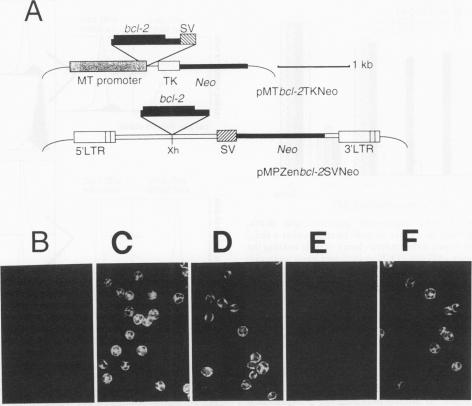
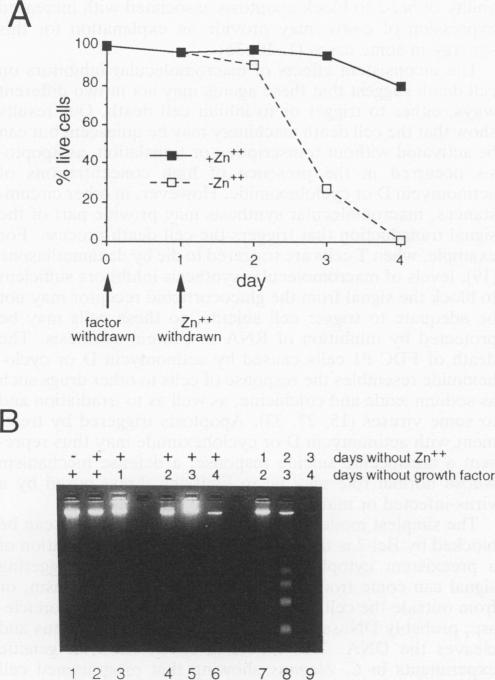
Expression of c-myc and macromolecular synthesis have been associated with physiological cell death. We have studied their requirement for the death of factor (interleukin-3)-dependent cells (FDC-P1) bearing an inducible bcl-2 expression construct. FDC-P1 cells expressing bcl-2 turned off expression of c-myc when deprived of interleukin-3 but remained viable as long as bcl-2 was maintained. A subsequent decline in Bcl-2 allowed the cells to undergo apoptosis directly from G0, in the absence of detectable c-myc expression. Thus c-myc expression may lead to apoptosis in some cases but is not directly involved in the mechanism of physiological cell death that can be controlled by Bcl-2. The macromolecular synthesis inhibitors actinomycin D and cycloheximide triggered rapid cell death of FDC-P1 cells in the presence of interleukin-3, but the cells could be protected by Bcl-2. Thus, the cell death machinery can exist in a quiescent state and can be activated by mechanisms that do not require synthesis of RNA or protein.
c-myc的表达和大分子合成与生理性细胞死亡有关。我们研究了携带可诱导bcl-2表达构建体的因子(白细胞介素-3)依赖性细胞(FDC-P1)死亡对它们的需求。当缺乏白细胞介素-3时,表达bcl-2的FDC-P1细胞关闭c-myc的表达,但只要bcl-2得以维持,细胞就保持存活。随后Bcl-2水平下降,使细胞在没有可检测到的c-myc表达的情况下直接从G0期发生凋亡。因此,c-myc表达在某些情况下可能导致凋亡,但并不直接参与可由Bcl-2控制的生理性细胞死亡机制。大分子合成抑制剂放线菌素D和环己酰亚胺在有白细胞介素-3存在的情况下引发FDC-P1细胞的快速死亡,但细胞可被Bcl-2保护。因此,细胞死亡机制可以处于静止状态,并可被不需要RNA或蛋白质合成的机制激活。