Valetti C, Sitia R
DIBIT-San Raffaele Scientific Institute, Milano, Italy.
Mol Biol Cell. 1994 Dec;5(12):1311-24. doi: 10.1091/mbc.5.12.1311.
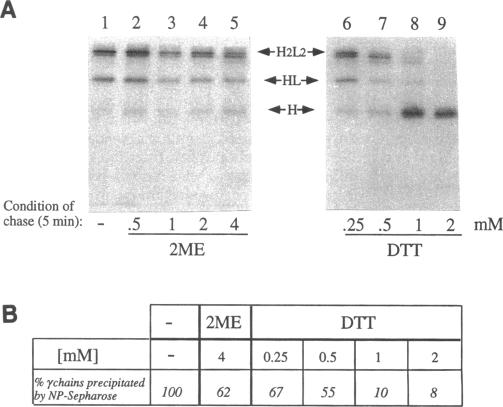
Dithiothreitol (DTT) blocks the endoplasmic reticulum (ER)-Golgi transport of newly synthesized immunoglobulin (Ig) molecules, whereas 2-mercaptoethanol (2ME) allows secretion of unpolymerized Igs otherwise retained intracellularly by disulphide interchange reactions. To understand this dichotomy, we have compared the effects of DTT and 2ME on the assembly, intracellular transport, and secretion of a panel of chimeric Igs that are either constitutively secreted or retained intracellularly. Our results demonstrate that DTT, but not 2ME, reduces some of the inter- and intrachain disulphide bonds and causes partial disassembly of H2L2 complexes and unfolding of individual chains in the ER. Upon DTT removal, heavy (H) and light (L) chains reform hapten-binding H2L2 molecules, which are later secreted. Reduction of the H2L2 interchain disulphide bonds can occur along the entire secretory pathway; however, in or beyond the Golgi this does not result in efficient H-L disassembly or unfolding. As a consequence, DTT does not block the exit from the Golgi. Moreover, unpolymerized Igs--normally retained in a pre-Golgi compartment--no longer require reducing agents to be secreted once they have reached the Golgi. Thus, little if any thiol-mediated retention seems to take place in or beyond the Golgi complex.
二硫苏糖醇(DTT)可阻断新合成的免疫球蛋白(Ig)分子在内质网(ER)与高尔基体之间的转运,而2-巯基乙醇(2ME)则能使原本因二硫键交换反应而滞留于细胞内的未聚合Ig分泌出去。为了理解这种差异,我们比较了DTT和2ME对一组嵌合Ig的组装、细胞内转运及分泌的影响,这些嵌合Ig要么组成性分泌,要么滞留于细胞内。我们的结果表明,DTT而非2ME会减少一些链间和链内二硫键,导致H2L2复合物部分解离,并使内质网中的单条链展开。去除DTT后,重链(H)和轻链(L)会重新形成结合半抗原的H2L2分子,随后分泌出去。H2L2链间二硫键的还原可发生在整个分泌途径中;然而,在高尔基体或其之后,这并不会导致高效的H-L解离或展开。因此,DTT不会阻断从高尔基体的输出。此外,未聚合的Ig——通常滞留于高尔基体前区室——一旦到达高尔基体,就不再需要还原剂来进行分泌。因此,在高尔基体复合体或其之后几乎没有巯基介导的滞留现象发生。